AirPods Pro 3 & Status Pro X share many similarities, but there are also important differences, such as quality, performance, features, design, and connectivity. If you want the best one between them, I Would recommend the AirPods Pro 3 rather than the Status Pro X.
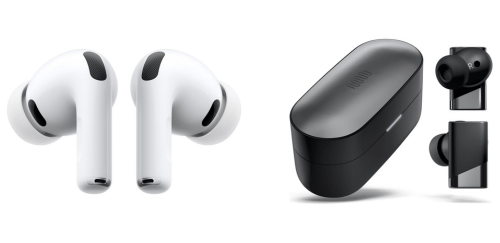
Why Do I Recommend The AirPods Pro 3?
- The AirPods Pro 3 features the Apple H2 chip for real-time adaptive audio processing and lower latency across Apple devices, whereas the Status Pro X uses standard Bluetooth DSP without a dedicated custom chip.
- AirPods Pro 3 supports personalized spatial audio with dynamic head tracking to create a directional 3D listening experience for movies and music, while the Status Pro X does not include spatial audio or head tracking functionality.
- It includes an optical heart rate sensor for tracking pulse data during workouts and daily use, whereas the Status Pro X does not include any biometric sensing hardware.
- The AirPods Pro 3 comes with seamless Apple ecosystem integration for automatic device switching, iCloud pairing, and system-level controls across iPhone, iPad, and Mac, while the Status Pro X operates as a standard cross-platform Bluetooth device without ecosystem-level integration.
- AirPods Pro 3 features adaptive transparency mode for dynamically reducing loud environmental noise while keeping speech audible in real time, whereas the Status Pro X uses a standard ambient mode without automatic real-time adjustment.
- It has up to 8 hours of battery life with active noise cancellation enabled for longer continuous listening sessions without recharging, while the Status Pro X has 5 hours with ANC active.
- The AirPods Pro 3 comes with multiple charging options including MagSafe, Qi wireless, USB-C, and Apple Watch charger compatibility for more flexible charging setups, while the Status Pro X supports only Qi wireless and USB-C charging.
- AirPods Pro 3 features IP57 water and dust resistance for improved durability against sweat, rain, and dust exposure during workouts or outdoor use, whereas the Status Pro X has an IP55 rating with lower protection against dust ingress.
Maybe the Status Pro X can make you comfortable because it’s a little bit cheaper than the AirPods Pro 3. But you have to compromise all the above-mentioned features. Now the Decision is Yours. I hope it was helpful to choose the right one.
Side-by-Side Comparison
| Feature | AirPods Pro 3 | Status Pro X |
| Chipset | Apple H2 chip | No custom chipset |
| Spatial audio | Personalized spatial audio + head tracking | Not supported |
| Heart rate sensor | Optical PPG sensor | Not available |
| Earbud battery (ANC on) | 8 hours | 4.5–5 hours |
| Charging methods | USB-C, Qi, MagSafe, Apple Watch charger | USB-C, Qi wireless |
| Case weight | 44 g | 48 g |
| Water resistance | IP57 | IP55 |
| Noise cancellation | −28.69 dB attenuation | Up to −52 dB ANC |
| Low-frequency extension | 20 Hz | Not specified |
| Max SPL | 106 dB | Not specified |
| Ear tip options | 5 sizes | Standard silicone tips |
| Wear detection | Automatic ear detection | Not available |
| App control | iOS system integration | Dedicated app with EQ |
| Price | Check AirPods Pro 3 Price | Check Status Pro X Price |
What Common Both Can Do?
- True wireless design: Both earbuds use a completely cable-free design, allowing independent operation of each earbud. This makes them convenient for daily use, commuting, and workouts without any physical connection between the earbuds.
- Active noise cancellation: Both earbuds feature ANC technology that reduces external noise using microphones and processing algorithms. This allows users to focus on music or calls in environments such as public transport or busy streets.
- Transparency / ambient mode: Each model includes a mode that lets outside sound pass through the microphones into the earbuds. This is useful for staying aware of surroundings while listening, such as hearing announcements or conversations.
- In-ear silicone tips: Both use interchangeable silicone ear tips to create a seal inside the ear canal. This improves comfort, stability, and passive noise isolation during extended listening sessions.
- Touch controls: Both earbuds support touch-sensitive controls on the outer surface for playback and call management. This allows users to control music and calls without reaching for their phone.
- Bluetooth connectivity: Each device uses modern Bluetooth technology for wireless audio transmission. This ensures compatibility with smartphones, tablets, and laptops across different platforms.
- Wireless charging: Both support Qi wireless charging for their cases, enabling cable-free recharging on compatible charging pads. This adds convenience for users who prefer a minimal cable setup.
- USB-C charging: Each charging case includes a USB-C port for wired charging. This standard connector allows faster and more universal charging compared to older ports.
- Built-in microphones: Both earbuds include multiple microphones for capturing voice input. This supports clear communication during calls and enables voice assistant interaction.
- Voice call support: Each model supports hands-free calling with integrated microphones and audio processing. This makes them suitable for work calls and everyday communication.
- Portable charging case: Both come with a compact charging case that stores and recharges the earbuds. This extends total battery life and makes them easy to carry in a pocket or bag.
- Stereo audio output: Both deliver true stereo sound with separate left and right channels. This provides a more immersive listening experience compared to mono audio.
- Firmware updates: Each product supports firmware updates that can improve performance or add features over time. This helps maintain compatibility and enhance functionality after purchase.
- Companion app / software control: Both earbuds provide software-level control through either system integration or a dedicated app. This allows users to adjust settings such as controls, sound preferences, or modes.
- Rechargeable battery: Both use built-in rechargeable batteries instead of disposable cells. This makes them more convenient and environmentally friendly for long-term use.
- Auto pairing: Each device supports automatic pairing with previously connected devices. This reduces setup time and provides a seamless reconnection experience.
- Noise-isolating seal: Both rely on a sealed in-ear fit to block passive noise. This improves audio clarity and enhances the effectiveness of active noise cancellation.
Common Features
| Feature | AirPods Pro 3 | Status Pro X |
| True wireless design | Yes | Yes |
| Active noise cancellation | Yes | Yes |
| Transparency / ambient mode | Yes | Yes |
| In-ear silicone tips | Yes | Yes |
| Touch controls | Yes | Yes |
| Bluetooth connectivity | Bluetooth 5.x | Bluetooth 5.x |
| Wireless charging | Qi wireless | Qi wireless |
| USB-C charging | Yes | Yes |
| Built-in microphones | Yes | Yes |
| Voice call support | Yes | Yes |
| Portable charging case | Yes | Yes |
| Stereo audio output | Yes | Yes |
| Firmware updates | Yes | Yes |
| Companion app / software control | Yes | Yes |
| Rechargeable battery | Yes | Yes |
| Auto pairing | Yes | Yes |
| Noise-isolating seal | Yes | Yes |
| Price | Check AirPods Pro 3 Price | Check Status Pro X Price |
FAQ
Do both AirPods Pro 3 and Status Pro X support active noise cancellation? Which earbuds have better sound quality? Do both earbuds support wireless charging? Which earbuds have longer battery life? Are both earbuds compatible with Android and iOS devices? Do AirPods Pro 3 and Status Pro X support multipoint connection? Do both earbuds have a transparency or ambient mode? Which earbuds are better for Apple users? Do both earbuds support touch controls? Are both earbuds water resistant? Do either of the earbuds support spatial audio? Can both earbuds be used for phone calls? Do both models receive software or firmware updates? Which earbuds are better for high-resolution audio streaming? |