Sony RX100 VII comes with a 20.1MP stacked CMOS sensor, blazing-fast 20 fps burst shooting, and real-time tracking autofocus in a truly pocket-sized body. If you are looking for a perfect balance between professional-grade performance, portability, and advanced video features, the Sony RX100 VII stands out as one of the most capable compact cameras available.
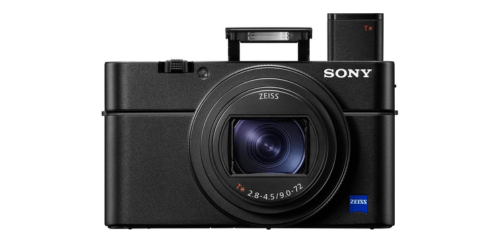
What Sony RX100 VII Offer?
- The Sony RX100 VII has a 20.1MP 1-inch Exmor RS stacked CMOS sensor for capturing high-resolution images with fast data readout and reduced rolling shutter distortion.
- Sony RX100 VII features a BIONZ X image processor with a front-end LSI to accelerate image processing, improve color accuracy, and reduce noise in low-light conditions.
- It has 357 phase-detection and 425 contrast-detection autofocus points for achieving fast subject acquisition and precise focus tracking across most of the frame.
- The Sony RX100 VII has real-time Tracking and Eye AF for maintaining sharp focus on human and animal subjects during portraits and action shots.
- Sony RX100 VII has 20 fps continuous shooting with blackout-free viewing for capturing fast-moving subjects without missing critical moments.
- It has a 24–200mm f/2.8–4.5 ZEISS zoom lens for flexible wide-angle to telephoto framing without changing lenses.
- The Sony RX100 VII has 4K video recording at 3840 × 2160 with full pixel readout for producing detailed footage suitable for professional editing and content creation.
- Sony RX100 VII has a 3.5mm microphone input for connecting external microphones to achieve clearer and more controlled audio recording.
- It has a 3.0-inch 921k-dot tilting LCD screen for convenient self-recording, high-angle, and low-angle shooting.
- Sony RX100 VII has built-in Wi-Fi and Bluetooth connectivity for transferring photos to smartphones and enabling remote camera control.
Pros & Cons
- 20.1MP stacked CMOS sensor with fast readout
20 fps continuous shooting with blackout-free EVF
Advanced real-time tracking and Eye AF
24–200mm versatile zoom range
4K video with full pixel readout
Compact 302 g body
3.5mm microphone input
Wi-Fi, Bluetooth, and NFC connectivity
- Fixed lens with no interchangeable option
No in-body image stabilization for sensor shift
Comparison
| Feature | Sony RX100 VII | Canon G7 X Mark III | Panasonic Lumix LX100 II |
| Sensor | 20.1MP 1-inch CMOS | 20.1MP 1-inch CMOS | 17MP Four Thirds MOS |
| Processor | BIONZ X | DIGIC 8 | Venus Engine |
| Autofocus Points | 357 phase + 425 contrast | 31 contrast | 49 contrast |
| Continuous Shooting | 20 fps | 20 fps | 11 fps |
| Single Burst Mode | 90 fps | No | No |
| Lens Range | 24–200mm f/2.8–4.5 | 24–100mm f/1.8–2.8 | 24–75mm f/1.7–2.8 |
| Video Resolution | 3840 × 2160 at 30p | 3840 × 2160 at 30p | 3840 × 2160 at 30p |
| Screen Size | 3.0-inch | 3.0-inch | 3.0-inch |
| Screen Resolution | 921k dots | 1.04M dots | 1.24M dots |
| Viewfinder | 2.36M-dot OLED | No | 2.76M-dot EVF |
| Microphone Port | 3.5mm | 3.5mm | No |
| USB Port | Micro USB | USB-C | Micro USB |
| Battery Life | 260 shots | 265 shots | 340 shots |
| Weight | 302 g | 304 g | 392 g |
| Connectivity | Wi-Fi, Bluetooth, NFC | Wi-Fi, Bluetooth | Wi-Fi, Bluetooth |
| Price | Check RX100 VII Price | Check Canon G7 X Price | Check LX100 II Price |
FAQ
Is the Sony RX100 VII good for professional photography? Does the Sony RX100 VII support 4K video recording? Can I connect an external microphone to the Sony RX100 VII? How good is the autofocus for moving subjects? Is the Sony RX100 VII suitable for travel photography? Does the camera have a viewfinder? How long does the battery last? Is the screen good for vlogging? Does the Sony RX100 VII have image stabilization? Can I transfer photos to my smartphone? Is the lens bright enough for low light? Is this camera good for sports photography? Does it support slow-motion video? Is the Sony RX100 VII beginner-friendly? Can it replace a DSLR or mirrorless camera? |