Ryzen 7 9800X3D & Ryzen 5 5500 share many similarities, but there are also important differences, such as quality, performance, features, design, and connectivity. If you want the best one between them, I Would recommend the Ryzen 7 9800X3D rather than the Ryzen 5 5500.
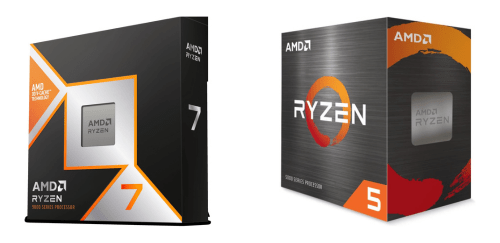
Why Do I Recommend The Ryzen 7 9800X3D?
- The AMD Ryzen 7 9800X3D has 8 cores and 16 threads for handling heavier multitasking workloads, high-refresh-rate gaming, and demanding productivity applications simultaneously, while the AMD Ryzen 5 5500 has 6 cores and 12 threads.
- AMD Ryzen 7 9800X3D comes with a 96MB L3 cache for reducing memory latency in CPU-bound gaming scenarios and maintaining higher minimum frame rates, whereas the AMD Ryzen 5 5500 uses a 16MB L3 cache.
- It features up to 5.2 GHz boost clock for sustaining higher single-core performance in competitive gaming and lightly threaded applications, while the AMD Ryzen 5 5500 has a maximum boost clock of up to 4.2 GHz.
- The AMD Ryzen 7 9800X3D supports DDR5-5600 memory for increased memory bandwidth in modern workloads such as content creation and high-speed data processing, while the AMD Ryzen 5 5500 supports DDR4-3200 memory.
- AMD Ryzen 7 9800X3D supports PCIe 5.0 for higher bandwidth connectivity with next-generation GPUs and NVMe SSDs, whereas the AMD Ryzen 5 5500 supports PCIe 3.0.
- It has a 4nm CPU die for higher transistor density and architectural efficiency in intensive computing tasks, while the AMD Ryzen 5 5500 uses a 7nm process node.
- The AMD Ryzen 7 9800X3D includes 8MB L2 cache for improving data access speed across all cores during sustained workloads, while the AMD Ryzen 5 5500 includes 3MB L2 cache.
- AMD Ryzen 7 9800X3D uses the AM5 socket for compatibility with newer chipsets such as X670E and B650 that support DDR5 and PCIe 5.0 technologies, whereas the AMD Ryzen 5 5500 uses the AM4 socket limited to older chipset generations.
Maybe the Ryzen 5 5500 can make you comfortable because it’s a little bit cheaper than the Ryzen 7 9800X3D. But you have to compromise all the above-mentioned features. Now the Decision is Yours. I hope it was helpful to choose the right one.
Side-by-Side Comparison
| Feature | Ryzen 7 9800X3D | Ryzen 5 5500 |
| CPU Architecture | Zen 5 with 3D V-Cache | Zen 3 |
| Process Node | 4nm + 6nm | 7nm |
| Core Count | 8 Cores | 6 Cores |
| Thread Count | 16 Threads | 12 Threads |
| Base Clock | 4700 MHz | 3600 MHz |
| Max Boost Clock | 5200 MHz | 4200 MHz |
| L2 Cache | 8MB | 3MB |
| L3 Cache | 96MB | 16MB |
| Total Cache | 104MB | 19MB |
| TDP (Default) | 120W | 65W |
| Socket Type | AM5 | AM4 |
| Memory Type | DDR5 | DDR4 |
| Memory Speed Support | Up to DDR5-5600 | Up to DDR4-3200 |
| PCIe Version | PCIe 5.0 | PCIe 3.0 |
| PCIe Lanes | 24 | 20 |
| Price | Check Ryzen 7 9800X3D Price | Check Ryzen 5 5500 Price |
What Common Both Can Do?
- CPU Type: Both processors are designed for desktop platforms, making them compatible with standard ATX, Micro-ATX, and Mini-ITX motherboard form factors. This ensures flexibility in building gaming, productivity, or general-purpose desktop systems.
- Manufacturer: Each processor is developed by AMD, meaning they share common engineering philosophies, firmware ecosystems, and software optimization strategies. This also ensures compatibility with AMD chipset drivers and Ryzen Master software.
- x86-64 Architecture: Both CPUs use the x86-64 instruction set architecture, allowing compatibility with modern operating systems such as Windows and Linux. This ensures support for mainstream applications, games, and productivity software.
- 64-bit Support: Each processor supports 64-bit computing, enabling access to more than 4GB of RAM. This is essential for modern multitasking, gaming engines, and professional workloads.
- SMT (Simultaneous Multithreading): Both models support SMT technology, allowing two threads per physical core. This improves multitasking efficiency and enhances performance in multi-threaded applications.
- Unlocked Multiplier: Both CPUs feature unlocked multipliers, allowing manual frequency tuning on supported motherboards. This provides flexibility for users who want to adjust performance parameters.
- Integrated Graphics: Neither processor includes integrated graphics, meaning a dedicated graphics card is required for display output. This makes them suitable for systems focused on discrete GPU performance.
- Overclocking Support: Both processors support overclocking on compatible chipsets. This allows users to experiment with higher clock speeds within thermal and voltage limits.
- PCIe Support: Each CPU provides PCI Express connectivity for GPUs and storage devices. This enables support for NVMe SSDs and modern expansion cards.
- Dual-Channel Memory: Both processors support dual-channel memory configurations. This improves memory bandwidth compared to single-channel setups.
- Max Operating Temperature: Each CPU has a maximum operating temperature of 95°C. This defines the upper thermal threshold for sustained operation.
- Virtualization Support: Both models include hardware virtualization technologies. This enables efficient operation of virtual machines for development and testing environments.
- AES Encryption Support: Each processor supports AES instruction acceleration. This improves performance in encrypted storage and secure data workloads.
- AMD Ryzen Platform: Both belong to the AMD Ryzen desktop processor family. This ensures support for AMD chipset features and BIOS-level optimizations.
- Integrated Memory Controller: Each processor includes an integrated memory controller within the CPU die. This reduces latency compared to older external memory controller designs.
- L3 Cache Presence: Both processors include shared L3 cache. This improves data access efficiency between cores.
- L2 Cache Presence: Each CPU contains dedicated L2 cache per core. This helps reduce memory access latency during active workloads.
Common Features
| Feature | Ryzen 7 9800X3D | Ryzen 5 5500 |
| CPU Type | Desktop Processor | Desktop Processor |
| Manufacturer | AMD | AMD |
| x86-64 Architecture | Yes | Yes |
| 64-bit Support | Yes | Yes |
| SMT (Simultaneous Multithreading) | Yes | Yes |
| Unlocked Multiplier | Yes | Yes |
| Integrated Graphics | No | No |
| Overclocking Support | Yes | Yes |
| PCIe Support | Yes | Yes |
| Dual-Channel Memory | Yes | Yes |
| Max Operating Temperature | 95°C | 95°C |
| Virtualization Support | Yes | Yes |
| AES Encryption Support | Yes | Yes |
| AMD Ryzen Platform | Yes | Yes |
| Integrated Memory Controller | Yes | Yes |
| L3 Cache Presence | Yes | Yes |
| L2 Cache Presence | Yes | Yes |
| Price | Check Ryzen 7 9800X3D Price | Check Ryzen 5 5500 Price |
FAQ
Is Ryzen 7 9800X3D better than Ryzen 5 5500 for gaming? Which processor has more cores and threads? Do both CPUs require a dedicated graphics card? What socket does Ryzen 7 9800X3D use compared to Ryzen 5 5500? What type of memory does each processor support? What is the maximum supported memory speed? How much L3 cache does each processor have? What is the default TDP of both processors? Which CPU supports newer PCIe standards? Are both processors unlocked for overclocking? What is the maximum operating temperature for both CPUs? Which processor is built on a newer manufacturing process? Which chipsets are compatible with each CPU? Do both processors support virtualization technologies? Which processor is more suitable for long-term platform upgrades? |