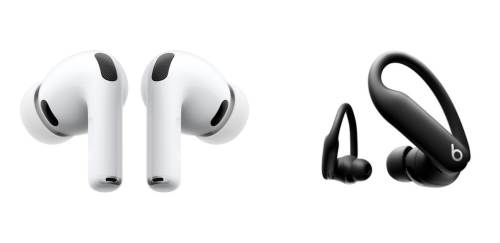
AirPods Pro 3 & Powerbeats Pro 2 share many similarities, but there are also important differences, such as quality, performance, features, design, and connectivity. If you want the best one between them, I Would recommend the AirPods Pro 3 rather than the Powerbeats Pro 2.
Why Do I Recommend The AirPods Pro 3?
- The AirPods Pro 3 features the Apple H3 chip for faster real-time audio processing and improved adaptive noise control accuracy, while the Powerbeats Pro 2 uses the Apple H2 chip.
- AirPods Pro 3 includes adaptive active noise cancellation for continuously adjusting noise reduction based on the environment and maintaining consistent audio clarity, whereas the Powerbeats Pro 2 uses standard hybrid ANC with manual adjustment.
- It supports personalized spatial audio with dynamic head tracking for a more precise and immersive 3D listening experience, while the Powerbeats Pro 2 supports standard spatial audio without personalization.
- The AirPods Pro 3 comes with a MagSafe and Qi wireless charging case for convenient cable-free charging across multiple charging pads and Apple accessories, whereas the Powerbeats Pro 2 uses a USB-C wired charging case only.
- AirPods Pro 3 includes the U2 ultra wideband chip for precise location tracking and directional finding through the Find My network, while the Powerbeats Pro 2 relies on standard Bluetooth tracking without precision finding.
- It supports Conversation Awareness for automatically lowering media volume and enhancing voices when speaking with others without removing the earbuds, while the Powerbeats Pro 2 does not include this feature.
- The AirPods Pro 3 includes a case with a built-in speaker for audible location alerts and easier recovery when misplaced, whereas the Powerbeats Pro 2 case does not include a built-in speaker.
- It features a compact 5.4 g earbud design for reduced ear fatigue and improved comfort during long listening sessions, whereas the Powerbeats Pro 2 uses a heavier 9 g earbud with an ear hook structure.
Maybe the Powerbeats Pro 2 can make you comfortable because it’s a little bit cheaper than the AirPods Pro 3. But you have to compromise all the above-mentioned features. Now the Decision is Yours. I hope it was helpful to choose the right one.
Side-by-Side Comparison
| Feature | AirPods Pro 3 | Powerbeats Pro 2 |
| Chipset | Apple H3 | Apple H2 |
| Ultra Wideband | U2 chip | Not supported |
| Microphones per Earbud | 3 | 2 |
| Charging Type | USB-C + Qi + MagSafe | USB-C only |
| Wireless Charging | Yes | No |
| Heart Rate Sensor | Optical PPG | Optical sensor |
| Water Resistance | IP57 | IPX4 |
| Driver Size | 11 mm | 9.5 mm |
| ANC Reduction | ~90% noise reduction | ~83% noise reduction |
| Battery (Earbuds ANC On) | ~9 hours | ~8 hours |
| Control Type | Capacitive touch + swipe | Physical buttons + rocker |
| Spatial Audio Type | Personalized + head tracking | Standard spatial audio |
| EQ Type | Adaptive EQ | Fixed tuning |
| Case Speaker | Built-in | Not available |
| Precision Tracking | UWB Precision Finding | Bluetooth tracking only |
| Case Pairing Method | Gesture-based | Physical pairing button |
| Frequency Response Profile | Near-flat with bass boost | U-shaped |
| Auto Device Switching | iCloud automatic switching | Manual switching required |
| Conversation Awareness | Yes | Not available |
| Dust Resistance | Yes | Not specified |
| Price | Check AirPods Pro 3 Price | Check Powerbeats Pro 2 Price |
What Common Both Can Do?
- True Wireless Design: Both earbuds use a fully wireless design with no cables connecting the earbuds. This allows unrestricted movement and makes them convenient for commuting, workouts, and everyday use.
- In-Ear Fit with Silicone Tips: Each model uses silicone ear tips to create a seal inside the ear canal. This improves passive noise isolation and helps maintain consistent audio performance.
- Active Noise Cancellation: Both earbuds feature ANC technology that reduces external noise. This allows users to focus on audio playback in noisy environments such as travel or public spaces.
- Transparency Mode: Each model includes a transparency mode that lets outside sound pass through. This helps users stay aware of their surroundings without removing the earbuds.
- Spatial Audio Support: Both support spatial audio processing for a more immersive listening experience. This enhances directional sound and creates a wider soundstage for music and video content.
- Bluetooth Connectivity: Both devices connect wirelessly using Bluetooth technology. This ensures compatibility with a wide range of smartphones, tablets, and computers.
- Bluetooth Version: Each model uses Bluetooth 5.3 for stable connections and improved power efficiency. This helps maintain consistent audio streaming with minimal dropouts.
- AAC Audio Codec: Both earbuds support the AAC codec, which is optimized for Apple devices. This ensures better audio quality and efficient data transmission.
- SBC Audio Codec: Both also support the SBC codec for universal compatibility. This allows them to work with non-Apple devices without connection issues.
- Built-in Microphones: Each earbud includes integrated microphones for voice pickup. This enables clear communication during calls and supports voice assistant functionality.
- Hands-Free Calling: Both models allow users to make and receive calls without using their phone. This adds convenience for multitasking and on-the-go communication.
- Siri Support: Both earbuds support Apple’s Siri voice assistant. This allows users to control playback, adjust settings, and access information using voice commands.
- Sweat Resistance: Both are designed to resist sweat during workouts. This improves durability and reliability during exercise or outdoor use.
- USB-C Charging: Each model uses a USB-C charging interface for the case. This provides faster charging and compatibility with modern cables.
- Fast Charging: Both earbuds support quick charging functionality. A short charging time provides several hours of playback, which is useful for urgent use.
- Multi-Device Pairing: Both can pair with multiple devices within the Apple ecosystem. This allows seamless switching between devices like iPhones, iPads, and Macs.
- Automatic Ear Detection: Each model can detect when the earbuds are in the ears. This automatically pauses or resumes playback, improving convenience and battery efficiency.
- Noise-Isolating Design: Both use a sealed in-ear structure that reduces ambient noise passively. This enhances listening clarity even without active noise cancellation.
- Apple Ecosystem Integration: Both are designed to work smoothly with Apple devices. This enables features like quick pairing, device syncing, and unified control across devices.
Common Features
| Feature | AirPods Pro 3 | Powerbeats Pro 2 |
| True Wireless Design | Yes | Yes |
| In-Ear Fit with Silicone Tips | Yes | Yes |
| Active Noise Cancellation | Yes | Yes |
| Transparency Mode | Yes | Yes |
| Spatial Audio Support | Yes | Yes |
| Bluetooth Connectivity | Yes | Yes |
| Bluetooth Version | 5.3 | 5.3 |
| AAC Audio Codec | Yes | Yes |
| SBC Audio Codec | Yes | Yes |
| Built-in Microphones | Yes | Yes |
| Hands-Free Calling | Yes | Yes |
| Siri Support | Yes | Yes |
| Sweat Resistance | Yes | Yes |
| USB-C Charging | Yes | Yes |
| Fast Charging | Yes | Yes |
| Multi-Device Pairing | Yes | Yes |
| Automatic Ear Detection | Yes | Yes |
| Noise-Isolating Design | Yes | Yes |
| Apple Ecosystem Integration | Yes | Yes |
| Price | Check AirPods Pro 3 Price | Check Powerbeats Pro 2 Price |