Nintendo Switch OLED comes with a vibrant 7-inch OLED display, enhanced audio, and a wide adjustable kickstand for a more immersive and flexible gaming experience. If you are looking for a perfect balance between portability, home-console versatility, and improved visual quality, the Nintendo Switch OLED is a compelling option in the hybrid gaming space.
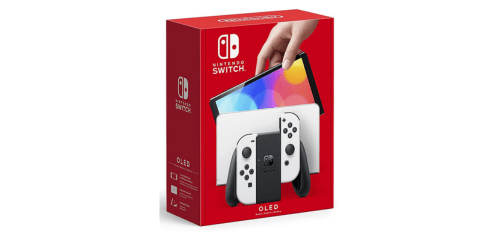
What Nintendo Switch OLED Offer?
- The Nintendo Switch OLED has a 7-inch OLED display for delivering deeper blacks, richer colors, and higher contrast that make handheld gameplay more immersive and visually vibrant.
- Nintendo Switch OLED has a custom NVIDIA Tegra processor for ensuring stable performance and smooth gameplay across handheld, tabletop, and TV modes.
- It has 64GB internal storage for storing more digital games and downloadable content without immediately requiring a microSD card.
- The Nintendo Switch OLED has enhanced onboard speakers for producing clearer and more balanced audio during handheld and tabletop gaming sessions.
- Nintendo Switch OLED has a wide adjustable kickstand for providing stable tabletop play with multiple viewing angles during multiplayer matches.
- It has a redesigned dock with a built-in LAN port for delivering more stable wired internet connectivity during online gaming.
- The Nintendo Switch OLED supports up to 1080p resolution in TV mode for displaying sharp visuals when connected to modern HDTVs.
- Nintendo Switch OLED has Bluetooth audio support for enabling direct connection to wireless headphones without additional adapters.
- It has a 4310 mAh battery for supporting approximately 4.5 to 9 hours of gameplay depending on the game load and brightness settings.
Pros & Cons
- 7-inch OLED screen with high contrast and vivid color reproduction
64GB internal storage
Wide adjustable kickstand for stable tabletop use
Dock with integrated LAN port
Hybrid design supporting handheld, tabletop, and TV modes
Enhanced audio quality in portable modes
- No performance upgrade over standard Switch
No native 4K output support
Battery life varies significantly depending on game intensity
Comparison
| Feature | Nintendo Switch OLED | Nintendo Switch | Nintendo Switch Lite |
| Processor | NVIDIA Custom Tegra | NVIDIA Custom Tegra | NVIDIA Custom Tegra |
| RAM | 4GB | 4GB | 4GB |
| Display Size | 7.0 inches | 6.2 inches | 5.5 inches |
| Display Type | OLED | LCD | LCD |
| Handheld Resolution | 1280 × 720 | 1280 × 720 | 1280 × 720 |
| TV Mode Resolution | 1920 × 1080 | 1920 × 1080 | Not Supported |
| Internal Storage | 64GB | 32GB | 32GB |
| Expandable Storage | microSD up to 2TB | microSD up to 2TB | microSD up to 2TB |
| Dock Included | Yes | Yes | No |
| LAN Port on Dock | Yes | No | Not Applicable |
| Battery Capacity | 4310 mAh | 4310 mAh | 3570 mAh |
| Battery Life | 4.5–9 hours | 4.5–9 hours | 3–7 hours |
| Weight with Joy-Con | 420 g | 398 g | 275 g |
| USB Port | USB-C | USB-C | USB-C |
| Bluetooth | Bluetooth 4.1 | Bluetooth 4.1 | Bluetooth 4.1 |
| Audio Output | Stereo Speakers | Stereo Speakers | Stereo Speakers |
| Price | Check Switch OLED Price | Check Switch Price | Check Switch Lite Price |
FAQ
Does Nintendo Switch OLED improve gaming performance compared to the original Switch? Is the Nintendo Switch OLED compatible with all existing Switch games? Can Nintendo Switch OLED connect to a TV? Does Nintendo Switch OLED support 4K resolution? How long does the Nintendo Switch OLED battery last? Can I use wireless headphones with Nintendo Switch OLED? Is the storage enough for digital games? What is the benefit of the built-in LAN port? Is the kickstand really different from the original model? Can I use my old Joy-Con controllers with Nintendo Switch OLED? Is Nintendo Switch OLED heavier than the standard model? Does the OLED screen make a noticeable difference? Is the Nintendo Switch OLED good for travel? Does Nintendo Switch OLED support multiplayer gaming? Is the Nintendo Switch OLED worth upgrading from the standard model? |