Netgear CM700 & ARRIS SB6190 share many similarities, but there are also important differences, such as quality, performance, features, design, and connectivity. If you want the best one between them, I Would recommend the Netgear CM700 rather than the ARRIS SB6190.
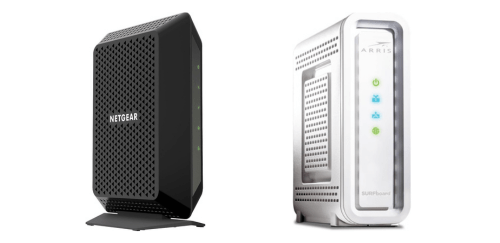
Why Do I Recommend The Netgear CM700?
- The Netgear CM700 has two 10/100/1000 Mbps Ethernet ports for supporting IEEE 802.3ad link aggregation and enabling up to 2 Gbps combined throughput to a compatible router, whereas the ARRIS SB6190 has one 10/100/1000 Mbps Ethernet port.
- Netgear CM700 supports IEEE 802.3ad LACP for distributing WAN traffic across two Gigabit links to reduce single-port bottlenecks during high-bandwidth downloads, while the ARRIS SB6190 does not support link aggregation.
- It comes with a Broadcom BCM3384 chipset for consistent packet processing and reduced latency variance under heavy streaming or gaming loads, whereas the ARRIS SB6190 uses the Intel Puma 6 chipset.
- The Netgear CM700 features dual Ethernet PHY controllers for managing two simultaneous wired connections to advanced routers or network switches, while the ARRIS SB6190 uses a single Ethernet PHY controller.
- Netgear CM700 includes separate LAN 1 and LAN 2 LED indicators for monitoring individual port activity and troubleshooting link status independently, while the ARRIS SB6190 includes a single Ethernet LED indicator.
- It has a 2-port LAN configuration for enabling aggregated connections on internet plans provisioned above 1 Gbps, whereas the ARRIS SB6190 has a single-port LAN configuration that limits wired throughput to 1 Gbps.
- The Netgear CM700 features a 7.3 × 4.5 × 1.9 inch chassis for a slim vertical footprint that fits narrow desk or shelf spaces, compared to the ARRIS SB6190’s 5.0 × 5.0 × 2.1 inch chassis with a wider base profile.
- Netgear CM700 comes with a black enclosure for integration with dark-colored networking equipment and rack environments, whereas the ARRIS SB6190 uses a white enclosure.
Maybe the ARRIS SB6190 can make you comfortable because it’s a little bit cheaper than the Netgear CM700. But you have to compromise all the above-mentioned features. Now the Decision is Yours. I hope it was helpful to choose the right one.
Side-by-Side Comparison
| Feature | Netgear CM700 | ARRIS SB6190 |
| Ethernet ports | 2 × 1GbE | 1 × 1GbE |
| Link aggregation | Yes | No |
| Aggregation standard | IEEE 802.3ad | Not supported |
| Max Ethernet link rate (aggregated) | 2 Gbps | Not supported |
| DOCSIS chipset family | Broadcom | Intel Puma 6 |
| DOCSIS chipset model | BCM3384 | Intel CE2600-series |
| Ethernet PHY count | 2 | 1 |
| Ethernet LED indicators | 2 | 1 |
| Front LED count (typical) | 6 | 5 |
| Chassis color | Black | White |
| Approx. dimensions (H × W × D) | 7.3 × 4.5 × 1.9 in | 5.0 × 5.0 × 2.1 in |
| Approx. weight | 0.8 lb | 1.1 lb |
| Price | Check Netgear CM700 Price | Check ARRIS SB6190 Price |
What Common Both Can Do?
- DOCSIS 3.0: Both modems use the DOCSIS 3.0 standard, which enables high-speed cable internet through channel bonding technology. This ensures compatibility with a wide range of cable ISPs that still deploy DOCSIS 3.0 infrastructure.
- Channel Bonding (32×8): Each device supports 32 downstream and 8 upstream channels. This allows stable data distribution across multiple channels for smoother streaming, gaming, and large downloads during peak hours.
- Maximum Downstream Speed (Up to 1.4 Gbps): Both models are rated for theoretical download speeds up to 1.4 Gbps. This makes them suitable for gigabit-class cable internet plans under DOCSIS 3.0 networks.
- Maximum Upstream Speed (Up to 262 Mbps): Each modem supports upstream speeds up to 262 Mbps. This helps maintain reliable upload performance for video calls, cloud backups, and content uploads.
- Backward Compatibility: Both units are backward compatible with DOCSIS 2.0 and earlier versions. This ensures operation even on older cable systems without requiring infrastructure upgrades.
- Gigabit Ethernet Port: Each modem includes a 10/100/1000 Mbps Ethernet interface. This allows connection to modern routers that can fully utilize gigabit-tier internet services.
- No Built-in WiFi: Both devices are pure cable modems without integrated WiFi radios. This gives users flexibility to pair them with a separate router of their choice for customized network setups.
- No Integrated Router: Neither model includes routing or NAT functionality. This simplifies configuration and reduces firmware complexity for users who prefer dedicated networking hardware.
- IPv6 Support: Both support IPv6 networking standards. This ensures long-term compatibility as ISPs gradually transition from IPv4 to IPv6 addressing systems.
- Modem-Only Design: Each product is designed specifically as a standalone modem. This focused design often results in straightforward installation and fewer configuration layers.
- Vertical Orientation: Both units are designed to stand upright. This reduces desk footprint and can help with passive airflow around the chassis.
- LED Status Indicators: Each modem includes front-facing LED indicators for power, downstream, upstream, and online status. These lights help users quickly diagnose connectivity issues.
- Web-Based Management UI: Both devices provide a local web interface for checking signal levels and connection status. This allows users to monitor performance metrics without additional software.
- Cable Provider Compatibility: Both modems are commonly approved for use with major cable internet providers. This broad compatibility makes activation and provisioning straightforward.
- F-Type Coaxial Connector: Each modem uses a standard F-type coaxial cable input. This ensures compatibility with typical residential cable installations.
- External Power Adapter: Both models use an external AC power adapter. This design allows easier replacement of the power supply if needed without servicing the modem itself.
Common Features
| Feature | Netgear CM700 | ARRIS SB6190 |
| DOCSIS standard | DOCSIS 3.0 | DOCSIS 3.0 |
| Channel bonding (downstream) | 32 channels | 32 channels |
| Channel bonding (upstream) | 8 channels | 8 channels |
| Maximum downstream speed (theoretical) | Up to 1.4 Gbps | Up to 1.4 Gbps |
| Maximum upstream speed (theoretical) | Up to 262 Mbps | Up to 262 Mbps |
| Backward compatibility | DOCSIS 2.0/1.1/1.0 | DOCSIS 2.0/1.1/1.0 |
| Ethernet port speed | 10/100/1000 Mbps | 10/100/1000 Mbps |
| WiFi built-in | No | No |
| Integrated router | No | No |
| IPv6 support | Yes | Yes |
| Modem-only design | Yes | Yes |
| Vertical orientation | Yes | Yes |
| LED status indicators | Yes | Yes |
| Web-based management UI | Yes | Yes |
| Cable provider compatibility | Major US cable ISPs | Major US cable ISPs |
| Coaxial input type | F-type connector | F-type connector |
| External power adapter | Yes | Yes |
| Price | Check Netgear CM700 Price | Check ARRIS SB6190 Price |
FAQ
Is Netgear CM700 compatible with the same internet providers as ARRIS SB6190? Do both modems support gigabit internet plans? What is the main hardware difference between Netgear CM700 and ARRIS SB6190? How many Ethernet ports do both modems have? Does either modem include built-in WiFi? Can Netgear CM700 exceed 1 Gbps speeds? Does ARRIS SB6190 support link aggregation? Are both modems backward compatible with older DOCSIS standards? What are the upstream and downstream channel bonding specifications? Do both modems support IPv6 networking? Is there a difference in warranty coverage? How do their physical sizes compare? Do both devices include a web-based management interface? What type of cable connection do they use? Are these modems suitable for gaming and streaming? |