Netgear CM2000 & Arris SURFboard S33 share many similarities, but there are also important differences, such as quality, performance, features, design, and connectivity. If you want the best one between them, I Would recommend the Netgear CM2000 rather than the Arris SURFboard S33.
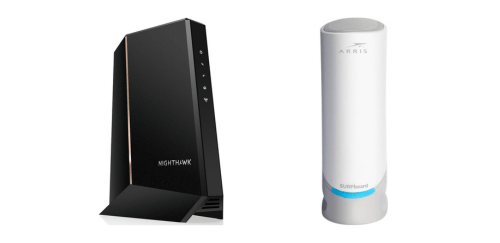
Why Do I Recommend The Netgear CM2000?
- The Netgear CM2000 has a single 2.5 Gigabit Ethernet port for dedicating the full multi-gig bandwidth to one high-performance router without port-sharing configuration, while the Arris S33 includes an additional 1 Gigabit Ethernet port alongside its 2.5 Gigabit port.
- Netgear CM2000 comes with a 12V 2.5A power adapter for delivering up to 30W of power to support stable operation under sustained multi-gigabit traffic loads, whereas the Arris S33 uses a 12V 1.5A power adapter.
- It features a Broadcom DOCSIS 3.1 chipset architecture for maintaining consistent downstream OFDM performance under high node congestion, while the Arris S33 uses a different Broadcom implementation with dual Ethernet port configuration.
- The Netgear CM2000 includes a vertically vented chassis with a full-length rear airflow channel for continuous passive heat dissipation during extended high-speed transfers, whereas the Arris S33 uses a compact vent grid layout with dual-port rear panel spacing.
- Netgear CM2000 supports a streamlined single-LAN hardware design to reduce direct device-to-modem connection complexity in single-router environments, while the Arris S33 includes two Ethernet LAN ports.
- It comes with six dedicated LED indicators for displaying power, downstream, upstream, internet, and Ethernet status in a simplified front-panel layout, while the Arris S33 includes seven LED indicators with dual-port activity display.
- The Netgear CM2000 features a single RJ-45 output path for preventing unintended multi-device ISP IP allocation in single-IP service plans, whereas the Arris S33 supports two RJ-45 Ethernet outputs.
- Netgear CM2000 supports 2.5GbE WAN throughput through one dedicated port to maximize direct router uplink bandwidth without secondary port negotiation, while the Arris S33 includes both a 2.5GbE port and an additional 1GbE port that share the same modem platform bandwidth.
Maybe the Arris SURFboard S33 can make you comfortable because it’s a little bit cheaper than the Netgear CM2000. But you have to compromise all the above-mentioned features. Now the Decision is Yours. I hope it was helpful to choose the right one.
Side-by-Side Comparison
| Feature | Netgear CM2000 | Arris SURFboard S33 |
| Upstream Channels | 8 | 8 |
| Maximum Downstream Speed | 2.5 Gbps | 2.5 Gbps |
| Maximum Upstream Speed | 1.0 Gbps | 1.0 Gbps |
| Ethernet WAN Port Count | 1 | 1 |
| Ethernet WAN Port Speed | 2.5 Gbps | 2.5 Gbps |
| Ethernet LAN Port Count | 1 | 2 |
| Power Supply Output | 12V DC, 2.5A | 12V DC, 1.5A |
| Power Consumption | 30 W | 18 W |
| Operating Temperature | 0 °C to 40 °C | 0 °C to 40 °C |
| Operating Humidity | 10 %–90 % | 10 %–90 % |
| Storage Temperature | -20 °C to 70 °C | -20 °C to 70 °C |
| Dimensions (H × W × D) | 6.73 × 5.04 × 1.52 in | 6.69 × 5.08 × 1.50 in |
| Weight | 0.95 lb | 0.88 lb |
| Price | Check Netgear CM2000 Price | Check Arris SURFboard S33 Price |
What Common Both Can Do?
- DOCSIS 3.1: Both modems support DOCSIS 3.1, which enables multi-gigabit download speeds and improved spectral efficiency over DOCSIS 3.0. This allows compatibility with modern high-speed cable internet plans and future ISP upgrades.
- Backward Compatibility: Each device remains compatible with DOCSIS 3.0 networks. This ensures functionality even if the ISP has not fully transitioned to DOCSIS 3.1 infrastructure.
- Downstream Channel Bonding: Both support 32×8 channel bonding under SC-QAM. This provides stable connectivity and efficient data distribution across multiple channels.
- OFDM Downstream Support: Both modems include OFDM technology for downstream traffic. This improves bandwidth efficiency and supports higher throughput under DOCSIS 3.1 standards.
- OFDMA Upstream Support: Each model supports OFDMA for upstream data transmission. This enhances upload stability and supports gigabit-tier upload plans where available.
- 2.5 Gigabit Ethernet Port: Both feature a 2.5GbE port for high-speed wired connections. This enables full utilization of internet plans exceeding 1 Gbps when paired with a compatible router.
- 4096-QAM Downstream Modulation: Both units use 4096-QAM modulation for downstream data. This increases data density per transmission cycle and supports higher throughput rates.
- 1024-QAM Upstream Modulation: Each modem supports 1024-QAM for upstream communication. This enhances upload efficiency and data reliability.
- IPv6 Support: Both devices support IPv6 networking. This ensures compatibility with modern internet addressing standards and future ISP infrastructure.
- IPv4 Support: Both remain fully compatible with IPv4. This guarantees connectivity across legacy systems and current ISP deployments.
- Bridge Mode: Each modem operates in bridge mode by design. This allows seamless pairing with external routers without double NAT complications.
- Modem-Only Design: Both are standalone cable modems without built-in routing or WiFi. This gives users flexibility to select separate high-performance routers.
- No Built-In WiFi: Neither device includes integrated wireless radios. This avoids performance limitations common in combo modem-router units.
- F-Type Coaxial Connector: Both use a standard F-Type coaxial connector. This ensures compatibility with standard cable ISP installations.
- LED Status Indicators: Each modem includes front-facing LED indicators. These provide quick visual diagnostics for power, connectivity, and activity status.
- Self-Activation Support: Both support ISP self-activation processes. This simplifies installation without requiring technician visits.
- Operating Temperature Range: Each device operates within 0°C to 40°C. This makes them suitable for standard indoor residential environments.
- Storage Temperature Range: Both support storage from -20°C to 70°C. This protects the hardware during shipping or long-term storage.
- Operating Humidity: Both function within 10%–90% non-condensing humidity. This ensures reliability in typical indoor conditions.
- Vertical Stand Design: Each modem uses a vertical tower-style chassis. This minimizes desk footprint and promotes airflow for heat dissipation.
Common Features
| Feature | Netgear CM2000 | Arris SURFboard S33 |
| DOCSIS Version | DOCSIS 3.1 | DOCSIS 3.1 |
| Backward Compatibility | DOCSIS 3.0 | DOCSIS 3.0 |
| Downstream Channel Bonding | 32×8 SC-QAM | 32×8 SC-QAM |
| OFDM Downstream Support | Yes | Yes |
| OFDMA Upstream Support | Yes | Yes |
| Max Multi-Gig Ethernet Port | 2.5 Gigabit Ethernet | 2.5 Gigabit Ethernet |
| Modulation Downstream | 4096-QAM | 4096-QAM |
| Modulation Upstream | 1024-QAM | 1024-QAM |
| IPv6 Support | Yes | Yes |
| IPv4 Support | Yes | Yes |
| Bridge Mode | Yes | Yes |
| Router Functionality | No | No |
| WiFi Built-In | No | No |
| Coaxial Connector Type | F-Type Female | F-Type Female |
| LED Status Indicators | Yes | Yes |
| ISP Activation | Self-Activation Supported | Self-Activation Supported |
| Operating Temperature | 0°C to 40°C | 0°C to 40°C |
| Storage Temperature | -20°C to 70°C | -20°C to 70°C |
| Operating Humidity | 10%–90% Non-Condensing | 10%–90% Non-Condensing |
| Vertical Stand Design | Yes | Yes |
| Price | Check Netgear CM2000 Price | Check Arris SURFboard S33 Price |
FAQ
Is the Netgear CM2000 faster than the Arris S33? Do both modems support multi-gig internet plans? Can the Arris S33 connect two devices directly via Ethernet? Does the Netgear CM2000 have built-in WiFi? Does the Arris S33 include routing features? Are both modems compatible with DOCSIS 3.0 networks? Do both devices support IPv6? What type of Ethernet port do they use for high-speed connections? Do these modems support OFDM and OFDMA technologies? Is there a difference in physical design between the two? Are both modems compatible with major U.S. cable ISPs? Do they require professional installation? Do both support 32×8 channel bonding? Is bridge mode available on these modems? Which modem is better for future-proofing? |