NETGEAR CM1200 & ARRIS SB8200 share many similarities, but there are also important differences, such as quality, performance, features, design, and connectivity. If you want the best one between them, I Would recommend the NETGEAR CM1200 rather than the ARRIS SB8200.
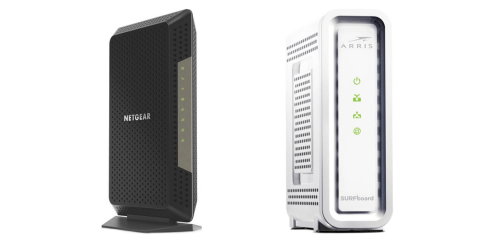
Why Do I Recommend The NETGEAR CM1200?
- The NETGEAR CM1200 features four Gigabit Ethernet ports for connecting up to four wired devices directly without adding a separate network switch, while the ARRIS SB8200 includes two Gigabit Ethernet ports.
- NETGEAR CM1200 supports up to four active IP address assignments from compatible ISPs to connect multiple public-facing devices simultaneously, whereas the ARRIS SB8200 supports up to two active IP assignments.
- It includes dedicated front-panel LED indicators for Ethernet ports 1–4 for clearer per-port activity monitoring and faster troubleshooting, while the ARRIS SB8200 shows only general connection status LEDs.
- The NETGEAR CM1200 has a vertical tower chassis design for improved passive airflow through side ventilation slots during sustained high-speed data transfers, whereas the ARRIS SB8200 uses a compact flat desktop enclosure.
- NETGEAR CM1200 comes with a 12V 1.5A power adapter for an 18W maximum draw that supports efficient power consumption under typical gigabit workloads, while the ARRIS SB8200 uses a 12V 2.0A 24W adapter.
- It features four separate rear Ethernet activity LEDs for identifying which wired device is transmitting data in real time, while the ARRIS SB8200 provides fewer visible per-port indicators.
- The NETGEAR CM1200 supports expanded wired LAN deployment scenarios to connect multiple routers, firewalls, or managed switches directly to the modem when enabled by ISP configuration, whereas the ARRIS SB8200 supports fewer simultaneous direct Ethernet connections.
- NETGEAR CM1200 includes a taller 10.3-inch chassis height for vertical placement in networking cabinets with narrow shelf depth, while the ARRIS SB8200 uses a 5.24-inch square flat form factor designed primarily for desktop placement.
Maybe the ARRIS SB8200 can make you comfortable because it’s a little bit cheaper than the NETGEAR CM1200. But you have to compromise all the above-mentioned features. Now the Decision is Yours. I hope it was helpful to choose the right one.
Side-by-Side Comparison
| Feature | NETGEAR CM1200 | ARRIS SB8200 |
| Ethernet ports (RJ-45) | 4 × 10/100/1000 | 2 × 10/100/1000 |
| Max active Ethernet ports with ISP multi-IP | Up to 4 | Up to 2 |
| Link aggregation ports | Ports 1 + 2 | Port 1 + Port 2 |
| Dimensions (in) | 10.3 × 6.1 × 3.4 | 5.24 × 5.24 × 1.65 |
| Dimensions (mm) | 261 × 155 × 87 | 133 × 133 × 42 |
| Weight | 1.22 lb | 2.1 lb |
| Form factor | Vertical tower | Flat square |
| Front diagnostic LEDs | Power, DS, US, Online, Ethernet 1–4 | Power, US/DS, Online |
| Rear diagnostic LEDs | Ethernet 1–4 link/activity | Ethernet link/speed |
| Status visibility per Ethernet port | Yes | No |
| Price | Check NETGEAR CM1200 Price | Check ARRIS SB8200 Price |
What Common Both Can Do?
- DOCSIS Standard: Both modems use DOCSIS 3.1 technology, which supports multi-gigabit download speeds and improved network efficiency. This ensures compatibility with modern cable internet plans and prepares the hardware for future ISP upgrades.
- DOCSIS 3.0 Backward Compatibility: Each device maintains backward compatibility with DOCSIS 3.0 networks. This allows them to function in areas where DOCSIS 3.1 has not yet been fully deployed.
- Downstream OFDM Channel: Both models include a downstream OFDM channel for high-capacity data transmission. OFDM improves spectral efficiency and supports higher throughput compared to legacy channel bonding alone.
- Upstream OFDMA Channel: Each modem supports upstream OFDMA technology. This enhances upload efficiency and reduces latency under network congestion.
- DOCSIS 3.0 Downstream Channels: Both devices support 32 bonded downstream DOCSIS 3.0 channels. Channel bonding improves data throughput and connection stability.
- DOCSIS 3.0 Upstream Channels: Each modem supports 8 bonded upstream DOCSIS 3.0 channels. This helps maintain consistent upload performance for streaming and video conferencing.
- Gigabit Ethernet Ports: Both include Gigabit Ethernet connectivity. This ensures wired devices can utilize high-speed internet connections without bottlenecks at the LAN port.
- Link Aggregation Support: Each modem supports Ethernet link aggregation. This enables combining two ports to increase available bandwidth when supported by the ISP and router.
- IPv6 Support: Both devices support IPv6 networking. This ensures compatibility with modern internet addressing standards and future network expansion.
- Quality of Service (QoS) Support: Each modem supports QoS features within the DOCSIS framework. This helps prioritize latency-sensitive traffic such as video calls and gaming.
- Cable Interface: Both models use a single F-type coaxial cable connector. This ensures standard compatibility with cable wall outlets and ISP infrastructure.
- LED Status Indicators: Each device includes front panel LED indicators. These provide visual feedback for power, connection status, and network activity.
- External Power Adapter: Both operate using an external 12V DC power adapter. This design simplifies power replacement and reduces internal heat buildup.
- Bridge Mode Operation: Each unit functions strictly as a cable modem without integrated routing features. Users must connect a separate Wi-Fi router for wireless networking.
- Built-in Wi-Fi: Neither model includes integrated Wi-Fi hardware. This allows users to pair the modem with a router of their choice for customized network setups.
- Voice/Telephone Ports: Both modems lack RJ-11 voice ports. They are intended for data-only cable internet plans.
- ISP Compatibility: Each model is certified for use with major U.S. cable internet providers. This ensures broad deployment compatibility across different regions.
- Firmware Updates via ISP: Both devices receive firmware updates directly from the internet service provider. This keeps the modem aligned with network standards and security requirements.
Common Features
| Feature | NETGEAR CM1200 | ARRIS SB8200 |
| DOCSIS Standard | DOCSIS 3.1 | DOCSIS 3.1 |
| DOCSIS 3.0 Backward Compatibility | Yes | Yes |
| Downstream OFDM Channel | Yes | Yes |
| Upstream OFDMA Channel | Yes | Yes |
| DOCSIS 3.0 Downstream Channels | 32 | 32 |
| DOCSIS 3.0 Upstream Channels | 8 | 8 |
| Gigabit Ethernet Ports | 1GbE | 1GbE |
| Link Aggregation Support | Yes | Yes |
| IPv6 Support | Yes | Yes |
| Quality of Service (QoS) Support | Yes | Yes |
| Cable Interface | 1 × F-Type Coaxial | 1 × F-Type Coaxial |
| LED Status Indicators | Yes | Yes |
| External Power Adapter | 12V DC | 12V DC |
| Bridge Mode Operation | Yes | Yes |
| Built-in Wi-Fi | No | No |
| Voice/Telephone Ports | No | No |
| ISP Compatibility | Major U.S. Cable ISPs | Major U.S. Cable ISPs |
| Firmware Updates via ISP | Yes | Yes |
| Price | Check NETGEAR CM1200 Price | Check ARRIS SB8200 Price |
FAQ
What internet speeds do NETGEAR CM1200 and ARRIS SB8200 support? Are NETGEAR CM1200 and ARRIS SB8200 compatible with major cable providers? Do NETGEAR CM1200 and ARRIS SB8200 have built-in Wi-Fi? How many Ethernet ports do NETGEAR CM1200 and ARRIS SB8200 include? Do both modems support link aggregation? Are both modems backward compatible with DOCSIS 3.0? Do NETGEAR CM1200 and ARRIS SB8200 support IPv6? Can I use these modems for gaming and streaming? Do these modems support voice or telephone services? Are firmware updates handled automatically? Do both modems require professional installation? What type of cable connection do both modems use? Are NETGEAR CM1200 and ARRIS SB8200 future-proof? Do these modems support multi-gig internet plans? Which type of user are these modems best suited for? |