NETGEAR CM1100 & NETGEAR CM1000 share many similarities, but there are also important differences, such as quality, performance, features, design, and connectivity. If you want the best one between them, I Would recommend the NETGEAR CM1100 rather than the NETGEAR CM1000.
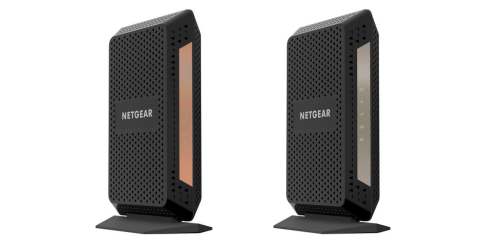
Why Do I Recommend The NETGEAR CM1100?
- The NETGEAR CM1100 supports link aggregation to combine two 1 Gbps Ethernet connections for up to 2 Gbps WAN-to-router throughput on compatible routers, while the NETGEAR CM1000 uses a single 1 Gbps Ethernet port without aggregation capability.
- NETGEAR CM1100 comes with two Gigabit Ethernet ports for connecting either two wired devices or a router with dual-WAN input configuration, whereas the NETGEAR CM1000 comes with one Gigabit Ethernet port only.
- It has a maximum rated download capacity of up to 2.0 Gbps for supporting multi-gigabit ISP plans with proper router configuration, while the NETGEAR CM1000 has a 1.0 Gbps rated maximum download speed.
- The NETGEAR CM1100 includes dual LAN port hardware for distributing wired bandwidth across two independent network paths, while the NETGEAR CM1000 includes single-port LAN hardware limited to one wired path.
- NETGEAR CM1100 supports aggregated WAN throughput to reduce bottlenecks on 1.2 Gbps and higher cable internet tiers, whereas the NETGEAR CM1000 supports non-aggregated WAN throughput capped at 1.0 Gbps.
- It features dual 10/100/1000 Mbps RJ-45 interfaces for flexible wired topology configurations in advanced home networks, while the NETGEAR CM1000 features one 10/100/1000 Mbps RJ-45 interface.
- The NETGEAR CM1100 supports simultaneous Ethernet port activation for multi-device direct connections in specific ISP provisioning scenarios, while the NETGEAR CM1000 supports activation through a single Ethernet interface.
- NETGEAR CM1100 includes firmware-level configuration options for enabling IEEE 802.3ad link aggregation to optimize bandwidth utilization with compatible routers, whereas the NETGEAR CM1000 does not include IEEE 802.3ad aggregation support.
Maybe the NETGEAR CM1000 can make you comfortable because it’s a little bit cheaper than the NETGEAR CM1100. But you have to compromise all the above-mentioned features. Now the Decision is Yours. I hope it was helpful to choose the right one.
Side-by-Side Comparison
| Feature | NETGEAR CM1100 | NETGEAR CM1000 |
| Max rated downstream speed | 2.0 Gbps | 1.0 Gbps |
| Number of LAN Ethernet ports | 2 | 1 |
| Link aggregation support | Yes | No |
| Combined LAN throughput potential | 2.0 Gbps | 1.0 Gbps |
| Power consumption (max) | Approx 15 W | Approx 14 W |
| Downstream channels | 32 | 24 |
| Aggregate port speed (combined) | 2.0 Gbps | N/A |
| Power consumption (idle) | ~11 W | ~9 W |
| Power consumption (max) | ~14 W | ~12 W |
| Max theoretical throughput | 2.0 Gbps | 1.0 Gbps |
| Price | Check NETGEAR CM1100 Price | Check NETGEAR CM1000 Price |
What Common Both Can Do?
- DOCSIS Version: Both modems support DOCSIS 3.1, which enables multi-gigabit download capabilities and improved spectral efficiency. This ensures compatibility with modern high-speed cable internet plans and future network upgrades.
- Backward Compatibility: Each device remains compatible with DOCSIS 3.0 networks. This allows them to operate on legacy infrastructure where DOCSIS 3.1 service is not fully deployed.
- Downstream Channels: Both support 32×8 channel bonding under DOCSIS 3.0. This provides stable multi-channel data transmission and improved performance under heavy network load.
- Upstream Channels: Each modem supports 8 upstream channels in DOCSIS 3.0 mode. This helps maintain consistent upload stability for cloud backups and video conferencing.
- OFDM Downstream: Both include OFDM downstream capability under DOCSIS 3.1. OFDM improves data efficiency and reduces latency compared to older modulation methods.
- OFDMA Upstream: Each modem supports OFDMA for upstream traffic. This enables better upload performance and more efficient bandwidth allocation.
- Downstream Modulation: Both support up to 4096 QAM downstream modulation. This increases data density over cable lines for higher throughput.
- Upstream Modulation: Each supports up to 1024 QAM upstream modulation. This allows higher upload speeds within DOCSIS 3.1 networks.
- Gigabit Ethernet Speed: Both include Gigabit Ethernet connectivity. This ensures wired devices can reach up to 1 Gbps over a single LAN connection.
- Coaxial Input: Each modem uses a single F-type coaxial connector for cable input. This standard interface ensures compatibility with typical residential cable installations.
- IPv6 Support: Both support IPv6 addressing. This allows compatibility with modern network standards and future-proof internet configurations.
- ISP Compatibility: Each modem is certified for major US cable providers. This ensures activation support and firmware compatibility across widely used ISPs.
- Form Factor: Both use a vertical tower design. This helps optimize airflow and reduce the desk footprint.
- LED Status Indicators: Each model includes LED indicators for power and connection status. These lights provide quick visual feedback for troubleshooting connectivity issues.
- Built-in Wi-Fi: Neither modem includes integrated Wi-Fi. This design focuses on pure modem functionality and requires a separate router for wireless networking.
- Built-in Router: Both operate strictly as cable modems without routing features. This allows users to pair them with a dedicated external router of their choice.
- Power Adapter Type: Each uses a 12V DC external power adapter. This ensures consistent electrical requirements across both models.
- Ventilation Design: Both rely on passive cooling with vented enclosures. This reduces noise and mechanical wear compared to fan-based cooling systems.
Common Features
| Feature | NETGEAR CM1100 | NETGEAR CM1000 |
| DOCSIS Version | DOCSIS 3.1 | DOCSIS 3.1 |
| Backward Compatibility | DOCSIS 3.0 | DOCSIS 3.0 |
| Downstream Channels | 32×8 | 32×8 |
| Upstream Channels | 8 | 8 |
| OFDM Downstream | Yes | Yes |
| OFDMA Upstream | Yes | Yes |
| Downstream Modulation | 4096 QAM | 4096 QAM |
| Upstream Modulation | 1024 QAM | 1024 QAM |
| Gigabit Ethernet Speed | 10/100/1000 Mbps | 10/100/1000 Mbps |
| Coaxial Input | 1 × F-Type | 1 × F-Type |
| IPv6 Support | Yes | Yes |
| ISP Compatibility | Major US Cable ISPs | Major US Cable ISPs |
| Form Factor | Vertical Tower | Vertical Tower |
| LED Status Indicators | Power/Downstream/Upstream/Internet/LAN | Power/Downstream/Upstream/Internet/LAN |
| Built-in Wi-Fi | No | No |
| Built-in Router | No | No |
| Power Adapter Type | 12V DC External | 12V DC External |
| Ventilation Design | Passive Cooling | Passive Cooling |
| Price | Check NETGEAR CM1100 Price | Check NETGEAR CM1000 Price |
FAQ
Do both modems support DOCSIS 3.1 technology? Are both models backward compatible with DOCSIS 3.0? Can either modem work without a separate Wi-Fi router? Is link aggregation available on both models? What is the maximum rated download speed of each modem? Do both modems support IPv6? How many Ethernet ports are available on each device? Do the two modems use the same type of cable connection? Are both devices compatible with major cable internet providers? Do these modems include built-in routing features? What type of Ethernet speed do both modems provide? Do both models support OFDM and OFDMA channels? What type of cooling system do these modems use? Are the physical designs of both modems similar? |