Netgear C7100V & ARRIS SVG2482AC share many similarities, but there are also important differences, such as quality, performance, features, design, and connectivity. If you want the best one between them, I Would recommend the Netgear C7100V rather than the ARRIS SVG2482AC.
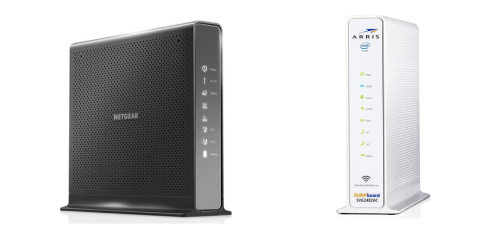
Why Do I Recommend The Netgear C7100V?
- The NETGEAR C7100V features AC1900 Wi-Fi with a 600 Mbps 2.4 GHz band for higher aggregate wireless throughput across mixed-device households, whereas the ARRIS SVG2482AC features AC1600 Wi-Fi with a 400 Mbps 2.4 GHz band.
- NETGEAR C7100V comes with 3×3 MIMO on the 2.4 GHz band for improved signal stability and sustained speeds when multiple legacy and IoT devices are connected, while the ARRIS SVG2482AC uses 2×2 MIMO on the 2.4 GHz band.
- It supports 256-QAM TurboQAM on the 2.4 GHz band to increase theoretical throughput to 600 Mbps under compatible conditions, while the ARRIS SVG2482AC uses standard 64-QAM on the 2.4 GHz band.
- The NETGEAR C7100V has a 600 Mbps 2.4 GHz maximum PHY rate for better bandwidth allocation to smart home devices and older Wi-Fi clients, whereas the ARRIS SVG2482AC has a 400 Mbps 2.4 GHz maximum PHY rate.
- NETGEAR C7100V includes dual telephone line support for handling two independent voice numbers simultaneously in residential or small office setups, while the ARRIS SVG2482AC supports a single voice line configuration.
- It features NETGEAR Nighthawk firmware integration for advanced traffic prioritization and configurable QoS controls within the Nighthawk ecosystem, while the ARRIS SVG2482AC uses the SURFboard firmware interface.
- The NETGEAR C7100V comes with a Nighthawk app management platform for remote monitoring, device control, and network adjustments from mobile devices, whereas the ARRIS SVG2482AC uses the SURFboard app platform with a different control environment.
- NETGEAR C7100V supports a 24×8 DOCSIS 3.0 channel bonding configuration combined with higher wireless class bandwidth for maximizing near-gigabit cable plans with stronger internal routing throughput, while the ARRIS SVG2482AC uses a 24×8 DOCSIS 3.0 configuration paired with a lower AC1600 wireless class.
Maybe the ARRIS SVG2482AC can make you comfortable because it’s a little bit cheaper than the Netgear C7100V. But you have to compromise all the above-mentioned features. Now the Decision is Yours. I hope it was helpful to choose the right one.
Side-by-Side Comparison
| Feature | Netgear C7100V | ARRIS SVG2482AC |
| Wi-Fi class | AC1900 | AC1600 |
| Rated Wi-Fi (2.4 GHz + 5 GHz) | 600 + 1300 Mbps | 400 + 1300 Mbps |
| 2.4 GHz max PHY rate | 600 Mbps | 400 Mbps |
| 2.4 GHz spatial streams | 3 | 2 |
| 2.4 GHz MIMO mode | 3×3 | 2×2 |
| 2.4 GHz 256-QAM support | TurboQAM | Standard 64-QAM |
| Voice line support | 2 lines | 1 line |
| Telephone ports | 2 x RJ-11 | 2 x RJ-11 |
| Router app | Nighthawk app | SURFboard app |
| Default management domain | routerlogin.net | 192.168.0.1 |
| Button set | Wi-Fi on/off + WPS | WPS + Wi-Fi |
| Price | Check Netgear C7100V Price | Check ARRIS SVG2482AC Price |
What Common Both Can Do?
- DOCSIS 3.0 Technology: Both devices use DOCSIS 3.0 cable modem technology, enabling high-speed broadband over coaxial cable networks. This ensures compatibility with most cable internet providers that still operate on DOCSIS 3.0 infrastructure.
- Built-in Cable Modem: Each unit integrates a cable modem directly into the device. This eliminates the need for a separate standalone modem, reducing equipment clutter and simplifying installation.
- Built-in Wi-Fi Router: Both models include a full routing system alongside the modem. This allows users to connect multiple wired and wireless devices without requiring an additional router.
- Dual-Band Wi-Fi: NETGEAR C7100V and ARRIS SVG2482AC both operate on 2.4 GHz and 5 GHz frequency bands. Dual-band capability allows users to separate devices by band to balance coverage and performance.
- 5 GHz Max Speed: Each device supports up to 1300 Mbps on the 5 GHz band. This makes them suitable for high-bandwidth tasks such as HD streaming and online gaming over compatible devices.
- Gigabit Ethernet Ports: Both units include four 10/100/1000 Mbps LAN ports. Gigabit ports ensure wired devices can utilize full broadband speeds without being limited by Fast Ethernet.
- Telephone Ports: Each model provides two RJ-11 telephone ports. This allows connection of landline phones for digital voice services.
- VoIP Support: Both gateways support Voice over IP through cable provider provisioning. This enables bundled internet and phone services through a single device.
- IPv4 / IPv6 Support: NETGEAR C7100V and ARRIS SVG2482AC both support IPv4 and IPv6 protocols. IPv6 compatibility ensures readiness for modern IP addressing standards.
- WPA/WPA2 Wireless Security: Both devices support WPA and WPA2 encryption standards. These security protocols protect wireless networks from unauthorized access.
- WPS Button: Each model includes a WPS button for simplified wireless pairing. This allows compatible devices to connect without manually entering a Wi-Fi password.
- USB 2.0 Port: Both devices include at least one USB 2.0 port. USB connectivity allows basic file sharing or peripheral connection depending on firmware configuration.
- Web-Based Management Interface: Each device provides a browser-based configuration portal. This allows users to adjust network settings, security parameters, and administrative controls.
- ISP Voice Provisioning Required: Both units require ISP activation for voice functionality. Phone services cannot operate without proper provider provisioning.
- Vertical Tower Design: NETGEAR C7100V and ARRIS SVG2482AC both use upright tower-style enclosures. This design supports airflow management and stable placement on desks or shelves.
- LED Status Indicators: Each device includes front-facing LED indicators for power, internet, Wi-Fi, and voice status. These lights provide real-time diagnostic visibility during setup and troubleshooting.
- Compatible with Major US Cable ISPs: Both gateways are designed for use with major cable internet providers in the United States. This broad compatibility makes them suitable replacements for ISP-rented modem/router combos.
Common Features
| Feature | Netgear C7100V | ARRIS SVG2482AC |
| DOCSIS 3.0 Technology | Yes | Yes |
| Built-in Cable Modem | Yes | Yes |
| Built-in Wi-Fi Router | Yes | Yes |
| Dual-Band Wi-Fi | 2.4 GHz + 5 GHz | 2.4 GHz + 5 GHz |
| 5 GHz Max Speed | 1300 Mbps | 1300 Mbps |
| Gigabit Ethernet Ports | 4 x 10/100/1000 Mbps | 4 x 10/100/1000 Mbps |
| Telephone Ports | 2 x RJ-11 | 2 x RJ-11 |
| VoIP Support | Yes | Yes |
| IPv4 / IPv6 Support | Yes | Yes |
| WPA/WPA2 Wireless Security | Yes | Yes |
| WPS Button | Yes | Yes |
| USB 2.0 Port | Yes | Yes |
| Web-Based Management Interface | Yes | Yes |
| ISP Voice Provisioning Required | Yes | Yes |
| Vertical Tower Design | Yes | Yes |
| LED Status Indicators | Yes | Yes |
| Compatible with Major US Cable ISPs | Yes | Yes |
| Price | Check Netgear C7100V Price | Check ARRIS SVG2482AC Price |
FAQ
Is NETGEAR C7100V compatible with all cable internet providers? Is ARRIS SVG2482AC approved for Xfinity voice service? What is the maximum internet speed supported by NETGEAR C7100V? What is the maximum internet speed supported by ARRIS SVG2482AC? Do both devices support 5 GHz Wi-Fi? How many wired devices can be connected directly? Do these gateways support telephone lines? Can I use my own router with these devices? Do NETGEAR C7100V and ARRIS SVG2482AC support IPv6? Is there a USB port for file sharing? Do these devices support dual-band Wi-Fi? Are firmware updates automatic? Can these devices replace ISP rental equipment? Do they support WPA2 wireless security? Is battery backup available for power outages? |