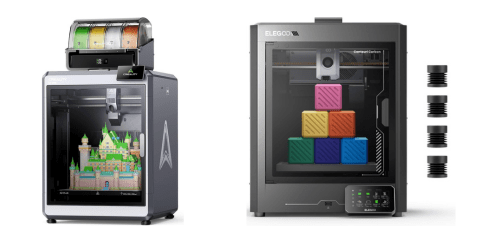
Creality K2 Plus & ELEGOO Centauri Carbon share many similarities, but there are also important differences, such as quality, performance, features, design, and connectivity. If you want the best one between them, I Would recommend the Creality K2 Plus rather than the ELEGOO Centauri Carbon.
Why Do I Recommend The Creality K2 Plus?
- The Creality K2 Plus has a 350 × 350 × 350 mm build volume for printing large functional parts and multi-piece assemblies in a single job without splitting models, while the ELEGOO Centauri Carbon has a 256 × 256 × 256 mm build volume.
- Creality K2 Plus features a maximum print speed of 600 mm/s for reducing production time on large prototypes and batch prints, whereas the ELEGOO Centauri Carbon has a maximum print speed of 500 mm/s.
- It has a maximum acceleration of 30,000 mm/s² for maintaining high-speed motion with reduced layer shift during rapid directional changes, while the ELEGOO Centauri Carbon has a maximum acceleration of 20,000 mm/s².
- The Creality K2 Plus comes with a 350°C maximum nozzle temperature for processing higher-temperature engineering polymers such as advanced nylon and composite blends, while the ELEGOO Centauri Carbon has a 320°C maximum nozzle temperature.
- Creality K2 Plus includes a 120°C heated bed for improving adhesion with high-warp materials like ABS and ASA during large-format prints, whereas the ELEGOO Centauri Carbon has a 110°C maximum bed temperature.
- It has an actively heated chamber reaching 60°C for stabilizing internal temperatures when printing temperature-sensitive engineering filaments, while the ELEGOO Centauri Carbon does not list an active chamber heating specification.
- The Creality K2 Plus supports CFS multi-color expansion up to 16 colors for producing complex multi-material and multi-color prints in a single automated workflow, while the ELEGOO Centauri Carbon does not list a multi-material expansion system.
- Creality K2 Plus includes a built-in Ethernet port and dual-band 2.4 GHz and 5 GHz WiFi for stable network connectivity in crowded or professional environments, whereas the ELEGOO Centauri Carbon supports WiFi connectivity without listing dual-band or Ethernet support.
Maybe the ELEGOO Centauri Carbon can make you comfortable because it’s a little bit cheaper than the Creality K2 Plus. But you have to compromise all the above-mentioned features. Now the Decision is Yours. I hope it was helpful to choose the right one.
Side-by-Side Comparison
| Feature | Creality K2 Plus | ELEGOO Centauri Carbon |
| Build Volume | 350 × 350 × 350 mm | 256 × 256 × 256 mm |
| Maximum Print Speed | 600 mm/s | 500 mm/s |
| Maximum Acceleration | 30,000 mm/s² | 20,000 mm/s² |
| Maximum Nozzle Temperature | 350°C | 320°C |
| Maximum Heated Bed Temperature | 120°C | 110°C |
| Chamber Temperature | 60°C | Not specified |
| Rated Power | 1200 W | 1100 W / 350 W |
| Machine Dimensions | 495 × 515 × 640 mm | 398 × 404 × 490 mm |
| Internal Storage | 32 GB eMMC | Not specified |
| WiFi Bands | 2.4 GHz / 5 GHz | Not specified |
| Ethernet Port | Yes | No |
| RFID Sensor | Yes | No |
| Air Purifier | Integrated | Not specified |
| Multi-Color Support | CFS up to 16 colors | Not specified |
| Bed Leveling Points | Auto Leveling | 121-Point Auto Leveling |
| Build Plate Type | Flexible Plate | Dual-Sided PEI Spring Steel |
| Supported Slicers | Creality Print 5.0+ | ELEGOO Slicer / Orca / Cura |
| Price | Check Creality K2 Plus Price | Check ELEGOO Centauri Carbon Price |
What Common Both Can Do?
- Fully Enclosed Frame: Both printers use a closed-frame design that helps maintain stable internal temperatures during printing. This structure also reduces external airflow interference and provides a controlled environment for engineering-grade materials.
- CoreXY Motion System: Each model uses a CoreXY kinematic system for precise and synchronized X–Y movement. This design supports high-speed printing while maintaining dimensional accuracy.
- Direct Drive Extruder: Both machines feature direct drive extrusion systems, placing the extruder motor close to the hotend. This configuration improves retraction control and supports flexible filaments.
- Auto Bed Leveling: Both printers include automatic bed leveling systems that measure multiple points on the build plate. This reduces manual adjustment and improves first-layer consistency.
- Heated Print Bed: Each model integrates a heated build platform to support materials such as ABS, PETG, and nylon. Controlled bed temperature improves adhesion and reduces warping.
- High-Speed Printing (≥500 mm/s): Both printers are designed for high-speed operation with rated speeds reaching 500 mm/s or higher. This enables faster production without relying on traditional low-speed profiles.
- Touchscreen Interface: Both devices use an integrated color touchscreen for printer control and monitoring. The interface simplifies calibration, file selection, and configuration adjustments.
- Built-in Camera: Each printer includes an internal camera for remote monitoring. This allows users to observe print progress and create timelapse recordings.
- WiFi Connectivity: Both models support wireless network connectivity. WiFi integration enables remote job submission and printer management.
- USB File Transfer: Each printer supports USB-based file transfer. This allows direct printing from removable storage devices without network dependency.
- Filament Runout Detection: Both printers feature filament detection sensors that pause printing when material is depleted. This prevents incomplete prints and material waste.
- Resume Printing After Power Loss: Each model supports power-loss recovery functionality. The printer can resume from the last recorded layer after unexpected interruptions.
- All-Metal Hotend: Both systems use all-metal hotend assemblies designed for high-temperature filament processing. This construction supports engineering and fiber-reinforced materials.
- PEI Build Surface: Each printer includes a PEI-coated build plate surface. PEI improves first-layer adhesion while allowing flexible part removal after cooling.
- 1.75 mm Filament Compatibility: Both machines are designed for standard 1.75 mm filament diameter. This ensures compatibility with widely available consumer and professional filament spools.
- Carbon Fiber Filament Support: Each printer supports carbon-fiber-reinforced materials when paired with hardened nozzles. This expands use cases to structural and load-bearing applications.
- Automatic Calibration Features: Both models integrate automated calibration systems such as input shaping or vibration compensation. These features optimize print stability and reduce manual tuning.
- 0.4 mm Default Nozzle: Each printer ships with a 0.4 mm nozzle as standard. This diameter balances print speed and detail resolution for general-purpose printing.
Common Features
| Feature | Creality K2 Plus | ELEGOO Centauri Carbon |
| Fully Enclosed Frame | Yes | Yes |
| CoreXY Motion System | Yes | Yes |
| Direct Drive Extruder | Yes | Yes |
| Auto Bed Leveling | Yes | Yes |
| Heated Print Bed | Yes | Yes |
| High-Speed Printing (≥500 mm/s) | Yes | Yes |
| Touchscreen Interface | Yes | Yes |
| Built-in Camera | Yes | Yes |
| WiFi Connectivity | Yes | Yes |
| USB File Transfer | Yes | Yes |
| Filament Runout Detection | Yes | Yes |
| Resume Printing After Power Loss | Yes | Yes |
| All-Metal Hotend | Yes | Yes |
| PEI Build Surface | Yes | Yes |
| 1.75 mm Filament Compatibility | Yes | Yes |
| Carbon Fiber Filament Support | Yes | Yes |
| Automatic Calibration Features | Yes | Yes |
| 0.4 mm Default Nozzle | Yes | Yes |
| Price | Check Creality K2 Plus Price | Check ELEGOO Centauri Carbon Price |
FAQ
What is the build volume of Creality K2 Plus and ELEGOO Centauri Carbon? Do both printers support high-speed printing? Are the printers fully enclosed? What type of motion system do they use? Do both printers support carbon fiber filaments? What is the maximum nozzle temperature for each printer? Do they include automatic bed leveling? Is WiFi connectivity available on both models? Do the printers have built-in cameras? What type of build surface do they use? Do they support power-loss recovery? What filament diameter do they use? Are the printers suitable for engineering-grade materials? Do they support USB file transfer? What type of extruder system do they use? |