Arduino Uno & ELEGOO Uno Carbon share many similarities, but there are also important differences, such as quality, performance, features, design, and connectivity. If you want the best one between them, I Would recommend the Arduino Uno rather than the ELEGOO Uno.
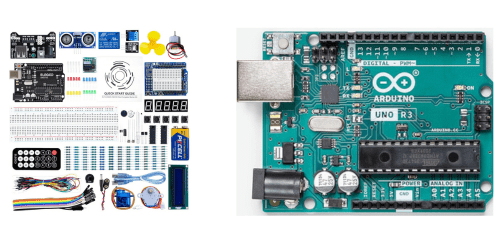
Why Do I Recommend The Arduino Uno?
- The ELEGOO Uno comes with a CH340 USB-to-serial chip for maintaining reliable serial communication at a lower manufacturing cost, while the Arduino Uno uses the ATmega16U2 USB interface chip.
- ELEGOO Uno includes bundled starter kit options for enabling beginners to start building circuits immediately without purchasing additional components, while the Arduino Uno is commonly sold as a standalone board.
- It features pre-included jumper wires and breadboard in many packages for faster hands-on experimentation without sourcing extra accessories, whereas the Arduino Uno package typically includes only the board.
- The ELEGOO Uno supports identical ATmega328P microcontroller specifications for running the same sketches and libraries without modification, while the Arduino Uno uses the same ATmega328P microcontroller at a higher board cost.
- ELEGOO Uno comes with a factory-installed Arduino-compatible bootloader for enabling immediate sketch uploads through the Arduino IDE, while the Arduino Uno uses the official Arduino Optiboot bootloader.
- It includes the 14 digital I/O pins and 6 PWM outputs for controlling LEDs, motors, and sensors without limiting hardware connections, whereas the Arduino Uno provides the same pin configuration at a higher purchase price.
- The ELEGOO Uno features the 32KB flash memory for supporting complex sketches and multiple libraries in embedded projects, while the Arduino Uno includes the same 32KB flash memory at a higher board cost.
Maybe the ELEGOO Uno can make you comfortable because it’s a little bit cheaper than the Arduino Uno. But you have to compromise all the above-mentioned features. Now the Decision is Yours. I hope it was helpful to choose the right one.
Side-by-Side Comparison
| Feature | Arduino Uno | ELEGOO Uno |
| Manufacturer | Arduino SA | ELEGOO |
| Country of Brand Origin | Italy | China |
| USB-to-Serial Chip | ATmega16U2 | CH340G |
| USB Chip Flash Memory | 16 KB | Not specified |
| USB Chip Firmware Updatable | Yes | No DFU mode support |
| USB Driver Requirement (Windows) | Native CDC driver | CH340 driver |
| PCB Color | Blue | Dark Blue |
| Silkscreen Logo | Arduino infinity logo | ELEGOO text logo |
| ICSP Header Labeling | ICSP + SPI labeled | ICSP labeled |
| Packaging Type | Retail cardboard box | Anti-static bag |
| Starter Kit Inclusion | Sold standalone | Common in kit bundles |
| USB Vendor ID | Arduino VID | WCH VID |
| USB Product ID | Arduino PID | CH340 PID |
| Microcontroller Socket Branding | Atmel logo | Microchip/blank marking |
| Documentation Source | docs.arduino.cc | elegoo.com tutorial PDF |
| Board Serial Number Printing | Printed batch code | No serial batch code |
| Price | Check Arduino Uno Price | Check ELEGOO Uno Price |
What Common Both Can Do?
- Microcontroller: Both boards use the ATmega328P microcontroller, which forms the core of their processing capabilities. This ensures identical instruction sets, timing behavior, and project compatibility across both boards.
- Operating Voltage: Each board operates at 5V logic level. This allows seamless use with standard 5V sensors, modules, and shields without voltage conversion.
- Input Voltage (Recommended): Both support a recommended input range of 7–12V. This ensures stable regulation when powered via external adapters or batteries.
- Input Voltage (Limits): Each board tolerates an input range between 6–20V. This flexibility helps accommodate different power supply options.
- Digital I/O Pins: Both provide 14 digital input/output pins. This enables the same number of LEDs, buttons, relays, and other digital devices to be connected.
- PWM Digital Pins: Each includes 6 PWM-capable pins. This allows identical control of motors, brightness levels, and analog-style output using pulse width modulation.
- Analog Input Pins: Both boards feature 6 analog inputs. This makes them equally capable of reading sensor voltages such as temperature, light, and potentiometer signals.
- Flash Memory: Each board includes 32KB of flash memory for storing programs. This determines how complex a sketch can be before reaching memory limits.
- SRAM: Both provide 2KB of SRAM. This memory is used during runtime for variables and data handling.
- EEPROM: Each board includes 1KB of EEPROM. This allows data storage that remains saved even after power is removed.
- Clock Speed: Both operate at 16 MHz. This ensures identical processing speed and timing behavior for code execution.
- USB Connector: Each board uses a USB Type-B connector. This provides the same physical cable requirement for programming and power via computer.
- DC Barrel Jack: Both use a 2.1mm center-positive barrel jack. This standardization simplifies adapter selection.
- ICSP Header: Each includes an ICSP header. This allows direct programming of the microcontroller and bootloader flashing.
- Reset Button: Both feature a hardware reset button. This allows manual restarting of the microcontroller during development or troubleshooting.
- LED Indicators: Each board includes ON, TX, RX, and L indicator LEDs. These provide visual feedback for power status and serial communication activity.
- Shield Compatibility: Both follow the Arduino Uno R3 shield layout. This ensures compatibility with the same expansion shields and add-on modules.
- Arduino IDE Support: Each board is programmable using the Arduino IDE. This ensures identical coding environment and library compatibility.
- Bootloader: Both use the Arduino Optiboot bootloader. This allows sketches to be uploaded via USB without additional hardware programmers.
- Board Dimensions: Both share the same 68.6 × 53.4 mm dimensions. This ensures identical mounting hole positions and enclosure compatibility.
Common Features
| Feature | Arduino Uno | ELEGOO Uno |
| Microcontroller | ATmega328P | ATmega328P |
| Operating Voltage | 5V | 5V |
| Input Voltage (Recommended) | 7–12V | 7–12V |
| Input Voltage (Limits) | 6–20V | 6–20V |
| Digital I/O Pins | 14 | 14 |
| PWM Digital Pins | 6 | 6 |
| Analog Input Pins | 6 | 6 |
| Flash Memory | 32KB | 32KB |
| SRAM | 2KB | 2KB |
| EEPROM | 1KB | 1KB |
| Clock Speed | 16 MHz | 16 MHz |
| USB Connector | USB Type-B | USB Type-B |
| DC Barrel Jack | 2.1mm center-positive | 2.1mm center-positive |
| ICSP Header | Yes | Yes |
| Reset Button | Yes | Yes |
| LED Indicators | ON, TX, RX, L | ON, TX, RX, L |
| Shield Compatibility | Yes | Yes |
| Arduino IDE Support | Yes | Yes |
| Bootloader | Arduino Optiboot | Arduino Optiboot |
| Board Dimensions | 68.6 × 53.4 mm | 68.6 × 53.4 mm |
| Price | Check Arduino Uno Price | Check ELEGOO Uno Price |