Beosound A1 3rd Gen & Sonos Roam share many similarities, but there are also important differences, such as quality, performance, features, design, and connectivity. If you want the best one between them, I Would recommend the Beosound A1 3rd Gen rather than the Sonos Roam.
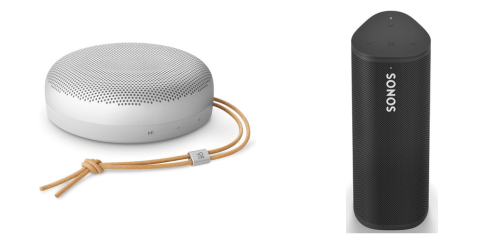
Why Do I Recommend The Beosound A1?
- The Beosound A1 3rd Gen features a 2-driver system with a dedicated woofer and tweeter for fuller sound separation and more accurate bass and treble reproduction, while the Sonos Roam uses a single full-range driver with a tweeter.
- Beosound A1 3rd Gen supports aptX Adaptive audio codec for higher bitrate Bluetooth streaming and reduced compression artifacts, while the Sonos Roam supports SBC and AAC only.
- It comes with 360-degree omnidirectional sound dispersion for consistent audio coverage in all directions without repositioning, whereas the Sonos Roam uses directional audio with adaptive orientation.
- The Beosound A1 3rd Gen includes Bluetooth multipoint connectivity for switching between two devices such as a phone and laptop without reconnecting, while the Sonos Roam does not support multipoint connections.
- Beosound A1 3rd Gen features 2 × 30W Class D amplifiers for higher output power and stronger volume headroom in open spaces, while the Sonos Roam uses dual Class-H digital amplifiers without specified wattage.
- It supports USB-C digital audio input for direct wired playback from compatible devices without Bluetooth compression, whereas the Sonos Roam does not support wired audio input.
- The Beosound A1 3rd Gen uses an anodized aluminum body with a leather strap for improved structural durability and resistance to surface wear during transport, while the Sonos Roam uses a polycarbonate and silicone enclosure.
- Beosound A1 3rd Gen offers 24-hour battery life for extended all-day playback without interruptions, whereas the Sonos Roam has a 10-hour battery life.
Maybe the Sonos Roam can make you comfortable because it’s a little bit cheaper than the Beosound A1 3rd Gen. But you have to compromise all the above-mentioned features. Now the Decision is Yours. I hope it was helpful to choose the right one.
Side-by-Side Comparison
| Feature | Beosound A1 3rd Gen | Sonos Roam |
| Audio Codec | SBC, AAC, aptX Adaptive | SBC, AAC |
| Battery Capacity Runtime | 24 hours | 10 hours |
| Driver Configuration | 1 × 3.25″ woofer + 1 × 0.6″ tweeter | 1 × full-range driver + 1 × tweeter |
| Amplification | 2 × 30W Class D | Dual Class-H digital amps |
| Total Output Power | 60W | Not specified |
| Frequency Range | 54 Hz – 20,000 Hz | Not specified |
| Sound Dispersion | 360° omnidirectional | 0° / 90° adaptive orientation |
| Max Sound Pressure Level | ~92 dB SPL | Not specified |
| Bluetooth Multipoint | Yes | No |
| Microphone System | 3-mic array | Far-field voice mic array |
| Stereo Pairing | Bluetooth stereo pair | Wi-Fi stereo pairing |
| App Control | Bang & Olufsen app | Sonos app |
| Wired Audio Input | USB-C digital audio supported | No wired input |
| Material | Anodized aluminum + leather strap | Polycarbonate + silicone |
| Price | Check Beosound A1 3rd Gen Price | Check Sonos Roam Price |
What Common Both Can Do?
- Bluetooth Audio Streaming: Both speakers support Bluetooth connectivity, allowing wireless audio playback from smartphones, tablets, and laptops. This ensures compatibility across a wide range of devices without requiring cables or network setup.
- Portable Speaker Design: Each model is designed as a compact portable speaker, making them suitable for travel, outdoor activities, and casual use. Their size and form factor allow easy placement in bags or on small surfaces.
- Built-in Rechargeable Battery: Both speakers include an internal rechargeable battery, eliminating the need for constant wired power. This enables use in environments where power outlets are not available.
- USB-C Charging Port: Each device uses a USB-C port for charging, which supports modern cable standards and faster charging compatibility. This also allows users to use widely available charging accessories.
- IP67 Water & Dust Resistance: Both models are rated IP67, meaning they are protected against dust ingress and can withstand immersion in water. This makes them suitable for outdoor environments such as beaches or pools.
- Outdoor Usage Support: Both speakers are engineered for outdoor use, with durable construction and environmental resistance. This allows reliable performance in varying weather conditions.
- Speakerphone Functionality: Each device supports hands-free calling through built-in microphones. This allows users to take calls directly from the speaker without switching devices.
- Integrated Microphones: Both speakers include multiple microphones for voice pickup. These microphones are used for calls and system interactions, ensuring clear voice transmission.
- Companion Mobile App: Each speaker is supported by a dedicated mobile app for configuration and control. These apps allow users to manage settings and customize audio behavior.
- Equalizer (EQ) Adjustment: Both models provide EQ controls through their apps, enabling users to adjust bass, treble, and sound profiles. This allows customization based on listening preferences or content type.
- Stereo Pairing Capability: Each speaker can be paired with another unit of the same model for stereo sound. This expands the audio experience by separating left and right channels.
- Firmware Updates via App: Both devices support firmware updates delivered through their respective apps. This ensures ongoing improvements, bug fixes, and feature enhancements.
- Compact Size Category: Both speakers fall within the compact portable category, allowing easy handling and placement. Their size supports mobility without sacrificing core functionality.
- Wireless Operation: Each model operates wirelessly without requiring a constant wired connection. This enhances convenience and flexibility in various usage scenarios.
- Lithium-ion Battery Type: Both speakers use lithium-ion battery technology, which provides stable energy density and recharge cycles. This contributes to consistent performance over time.
- Portable Carry Design: Each device includes design elements that support portability, such as straps or compact shapes. This makes it easier to carry or attach during travel.
- Mono Playback Support: Both speakers support mono audio playback as a single unit. This ensures consistent sound output when only one speaker is in use.
- Bluetooth Pairing Button: Each model includes a dedicated pairing mechanism for connecting devices via Bluetooth. This simplifies the connection process for users.
Common Features
| Feature | Beosound A1 3rd Gen | Sonos Roam |
| Bluetooth Audio Streaming | Yes | Yes |
| Portable Speaker Design | Yes | Yes |
| Built-in Rechargeable Battery | Yes | Yes |
| USB-C Charging Port | Yes | Yes |
| IP67 Water & Dust Resistance | Yes | Yes |
| Outdoor Usage Support | Yes | Yes |
| Speakerphone Functionality | Yes | Yes |
| Integrated Microphones | Yes | Yes |
| Companion Mobile App | Yes | Yes |
| Equalizer (EQ) Adjustment | Yes | Yes |
| Stereo Pairing Capability | Yes | Yes |
| Firmware Updates via App | Yes | Yes |
| Compact Size Category | Yes | Yes |
| Wireless Operation | Yes | Yes |
| Lithium-ion Battery Type | Yes | Yes |
| Portable Carry Design | Yes | Yes |
| Mono Playback Support | Yes | Yes |
| Bluetooth Pairing Button | Yes | Yes |
| Price | Check Beosound A1 3rd Gen Price | Check Sonos Roam Price |