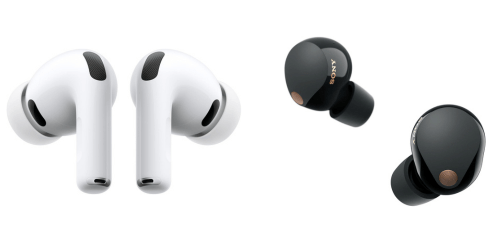
AirPods Pro 3 & Sony WF-1000XM5 share many similarities, but there are also important differences, such as quality, performance, features, design, and connectivity. If you want the best one between them, I Would recommend the AirPods Pro 3 rather than the Sony WF-1000XM5.
Why Do I Recommend The AirPods Pro 3?
- The AirPods Pro 3 features the Apple H2 chip for faster real-time audio processing and more efficient noise control during calls and media playback, while the Sony WF-1000XM5 uses the Sony V2 + QN2e processor.
- AirPods Pro 3 includes Personalized Spatial Audio with dynamic head tracking for maintaining consistent sound positioning when moving your head during videos or gaming, whereas the Sony WF-1000XM5 uses 360 Reality Audio with limited app compatibility.
- It comes with Adaptive Audio and Conversation Awareness for automatically lowering volume and enhancing voices when someone speaks nearby, while the Sony WF-1000XM5 uses manual ambient sound level adjustments.
- The AirPods Pro 3 supports seamless Apple ecosystem auto-switching for instantly moving audio between iPhone, iPad, and Mac without manual reconnection, whereas the Sony WF-1000XM5 uses standard multipoint switching between two devices.
- AirPods Pro 3 includes a U2 chip with Precision Finding for locating the charging case with directional guidance and distance tracking, while the Sony WF-1000XM5 has no ultra-wideband tracking feature.
- It features IP57-rated dust and water resistance for improved durability in dusty or wet environments including outdoor use, while the Sony WF-1000XM5 uses IPX4 water resistance without dust protection.
- The AirPods Pro 3 comes with MagSafe and Apple Watch charging compatibility for using multiple Apple chargers interchangeably without cables, whereas the Sony WF-1000XM5 supports standard Qi wireless charging only.
- AirPods Pro 3 includes built-in heart rate sensing for tracking basic biometric data during listening sessions or workouts, while the Sony WF-1000XM5 does not include any health monitoring sensors.
Maybe the Sony WF-1000XM5 can make you comfortable because it’s a little bit cheaper than the AirPods Pro 3. But you have to compromise all the above-mentioned features. Now the Decision is Yours. I hope it was helpful to choose the right one.
Side-by-Side Comparison
| Feature | AirPods Pro 3 | Sony WF-1000XM5 |
| Chipset | Apple H2 | Sony V2 + QN2e |
| ANC Reduction | ~90% attenuation | ~87% attenuation |
| Spatial Audio | Personalized + head tracking | 360 Reality Audio |
| EQ Control | Adaptive EQ | 6-band manual EQ |
| Ear Tip Type | Silicone + foam hybrid | Memory foam |
| Water Resistance | IP57 | IPX4 |
| Tracking Chip | U2 | None |
| Health Sensors | Heart rate sensor | None |
| App Support | System-level | Sony Headphones Connect |
| Voice Assistant | Siri | Google Assistant, Alexa |
| Charging Methods | USB-C, Qi, MagSafe, Apple Watch | USB-C, Qi |
| Audio Tuning | Mid-focused tuning | Bass-emphasized tuning |
| Live Translation | Supported | Not supported |
| Device Switching | Apple auto-switch | Manual + multipoint |
| Microphone System | Apple device-assisted processing | Onboard AI noise reduction |
| Price | Check AirPods Pro 3 Price | Check Sony WF-1000XM5 Price |
What Common Both Can Do?
- Active Noise Cancellation: Both earbuds feature active noise cancellation technology that reduces external sounds during playback. This allows users to focus on music, calls, or media without interference from surrounding noise.
- Transparency / Ambient Mode: Both models include a mode that lets outside sound pass through the microphones into the earbuds. This helps users stay aware of their environment while still listening to audio.
- Bluetooth Version: Both devices use Bluetooth 5.3 for wireless connectivity. This ensures stable connections, improved power efficiency, and compatibility with modern smartphones and devices.
- True Wireless Design: Each model operates without any physical cable between the earbuds. This design improves portability and allows completely independent use of each earbud.
- In-Ear Fit: Both earbuds use an in-ear design that seals inside the ear canal. This helps improve passive noise isolation and maintains a secure fit during movement.
- Touch Controls: Both support touch-sensitive surfaces for controlling playback and calls. Users can manage audio functions directly from the earbuds without using their phone.
- Wireless Charging: Both charging cases support Qi wireless charging. This allows users to recharge the case without cables using compatible charging pads.
- USB-C Charging: Each model uses a USB-C port for wired charging. This provides a universal and reversible connection for faster and more convenient charging.
- Fast Charging: Both earbuds support quick charging features that provide usable playback time within a few minutes. This is useful when the battery is low and immediate use is needed.
- Built-in Microphones: Both earbuds include multiple microphones for voice pickup. This enables clear communication during calls and supports voice assistant interactions.
- Call Noise Reduction: Each model applies noise reduction during calls to reduce background sounds. This helps maintain clearer voice transmission in noisy environments.
- Companion App Support: Both earbuds can be managed through software interfaces on connected devices. This allows users to adjust settings, controls, and firmware.
- Firmware Updates: Both models support firmware updates. This ensures ongoing improvements, bug fixes, and feature enhancements over time.
- Voice Assistant Support: Each model integrates with voice assistants. This enables hands-free control for tasks like playing music, making calls, or checking information.
- Auto Pause / Wear Detection: Both earbuds detect when they are removed from the ears. This automatically pauses playback and resumes when they are worn again.
- Multiple Ear Tip Sizes: Both include multiple ear tip options in the box. This helps users achieve a proper seal and comfortable fit for better audio performance.
- Stereo Audio: Both deliver stereo sound with separate left and right channels. This creates a more immersive listening experience with directional audio.
- Portable Charging Case: Each model includes a compact charging case for storage and power. This extends total battery life and makes the earbuds easy to carry.
Common Features
| Feature | AirPods Pro 3 | Sony WF-1000XM5 |
| Active Noise Cancellation | Yes | Yes |
| Transparency / Ambient Mode | Yes | Yes |
| Bluetooth Version | 5.3 | 5.3 |
| True Wireless Design | Yes | Yes |
| In-Ear Fit | Yes | Yes |
| Touch Controls | Yes | Yes |
| Wireless Charging | Qi | Qi |
| USB-C Charging | Yes | Yes |
| Fast Charging | Yes | Yes |
| Built-in Microphones | Yes | Yes |
| Call Noise Reduction | Yes | Yes |
| Companion App Support | Yes | Yes |
| Firmware Updates | Yes | Yes |
| Voice Assistant Support | Yes | Yes |
| Auto Pause / Wear Detection | Yes | Yes |
| Multiple Ear Tip Sizes | Yes | Yes |
| Stereo Audio | Yes | Yes |
| Portable Charging Case | Yes | Yes |
| Price | Check AirPods Pro 3 Price | Check Sony WF-1000XM5 Price |
FAQ
Are AirPods Pro 3 and Sony WF-1000XM5 both good for noise cancellation? Do both earbuds support wireless charging? Can both earbuds connect to multiple devices? Are both models compatible with Android and iOS devices? Do both earbuds have touch controls? Is there a difference in battery life between the two? Do both support voice assistants? Are both earbuds suitable for workouts? Do both have a transparency or ambient mode? Can both earbuds be used for phone calls? Do both earbuds support fast charging? Are both earbuds comfortable for long use? Do both have companion apps or software support? Do both earbuds automatically pause when removed? Which one is better for ecosystem integration? |