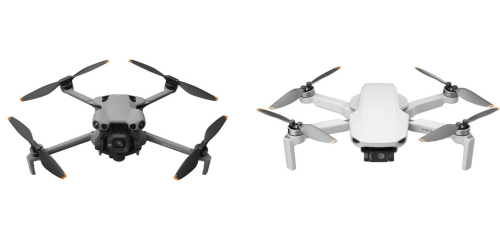
DJI Mini 5 Pro & DJI Mini 4K share many similarities, but there are also important differences, such as quality, performance, features, design, and connectivity. If you want the best one between them, I Would recommend the DJI Mini 5 Pro rather than the DJI Mini 4K.
Why Do I Recommend The DJI Mini 5 Pro?
- The DJI Mini 5 Pro features a 1-inch CMOS camera sensor for capturing higher dynamic range aerial photos and clearer low-light footage during sunrise or sunset flights, while the DJI Mini 4K uses a 1/2.3-inch CMOS sensor.
- DJI Mini 5 Pro supports 4K video recording at up to 120 fps to produce smoother slow-motion footage and more flexible editing options for cinematic aerial videos, whereas the DJI Mini 4K records 4K video at up to 30 fps.
- It includes omnidirectional obstacle sensing for safer autonomous flight and automatic collision avoidance when flying near buildings or trees, while the DJI Mini 4K has no obstacle sensing system.
- The DJI Mini 5 Pro comes with the DJI O4 video transmission system for maintaining a more stable live video feed and longer control range in environments with wireless interference, whereas the DJI Mini 4K uses the DJI O2 transmission system.
- DJI Mini 5 Pro supports native vertical shooting for capturing social media ready portrait-orientation aerial videos without cropping the frame, while the DJI Mini 4K records video only in horizontal orientation.
- It features ActiveTrack subject tracking for automatically following moving people, vehicles, or cyclists while keeping them centered in the frame during flight, whereas the DJI Mini 4K does not support subject tracking.
- The DJI Mini 5 Pro includes an extended battery option that supports up to about 52 minutes of flight time for completing longer aerial filming sessions without landing frequently, while the DJI Mini 4K supports about 31 minutes of maximum flight time.
- DJI Mini 5 Pro comes with built-in internal storage for saving photos and videos directly on the drone when a memory card is unavailable, whereas the DJI Mini 4K relies entirely on a microSD card for storage.
Maybe the DJI Mini 4K can make you comfortable because it’s a little bit cheaper than the DJI Mini 5 Pro. But you have to compromise all the above-mentioned features. Now the Decision is Yours. I hope it was helpful to choose the right one.
Side-by-Side Comparison
| Feature | DJI Mini 5 Pro | DJI Mini 4K |
| Camera Sensor | 1-inch CMOS | 1/2.3-inch CMOS |
| Effective Photo Resolution | 50 MP | 12 MP |
| Maximum Video Resolution | 4K (3840×2160) up to 120 fps | 4K (3840×2160) up to 30 fps |
| Slow Motion | 1080p at 240 fps | 1080p at 60 fps |
| Color Depth | 10-bit D-Log M | 8-bit color |
| Internal Storage | 42 GB | None |
| Video Transmission System | DJI O4+ | DJI O2 |
| Max Transmission Distance | 20 km | 10 km |
| Live View Quality | 1080p at 60 fps | 720p at 30 fps |
| Maximum Flight Time (Standard Battery) | 36 minutes | 31 minutes |
| Maximum Flight Time (Extended Battery) | 52 minutes | Not supported |
| Aircraft Weight | 249.9 g | 246 g |
| Folded Dimensions | 157 × 95 × 68 mm | 138 × 81 × 58 mm |
| Unfolded Dimensions | 255 × 181 × 91 mm | 245 × 289 × 56 mm |
| Gimbal Rotation Range | 225° roll rotation | −90° to 20° tilt |
| Obstacle Sensing | Omnidirectional sensors + LiDAR | None |
| Digital Zoom | Up to 10× | Up to 4× |
| Maximum Video Bitrate | 150 Mbps | 100 Mbps |
| GNSS Positioning | GPS + GLONASS + Galileo | GPS + GLONASS |
| Maximum Takeoff Altitude | 6000 m | 4000 m |
| Maximum Horizontal Speed | 19 m/s | 16 m/s |
| Battery Capacity | 2788 mAh | 2250 mAh |
| Supported Storage | microSD up to 512 GB | microSD up to 256 GB |
| Controller Compatibility | DJI RC 2 / RC-N3 | DJI RC-N1C |
| Vertical Shooting | Native vertical video | Not supported |
| Price | Check DJI Mini 5 Pro Price | Check DJI Mini 4K Price |
What Common Both Can Do?
- Sub-250 g Category: Both drones fall within the sub-250-gram weight class, which is significant for drone regulations in many regions. This lightweight category often allows users to fly with fewer restrictions and simplified registration requirements.
- Foldable Aircraft Design: Each drone features a foldable arm design that reduces its size when stored or transported. This design improves portability and makes the drones easier to carry in small bags or travel cases.
- 3-Axis Mechanical Gimbal: Both models use a three-axis mechanical gimbal to stabilize the camera during flight. This stabilization system helps maintain smooth video footage even when the drone experiences movement or wind.
- 4K Video Recording: Each drone supports 4K video recording capability. Recording in 4K provides high-resolution footage suitable for detailed aerial photography and video projects.
- JPEG Photo Format: Both drones can capture still images in JPEG format. This format allows quick storage and easy sharing of photos across most devices and editing software.
- microSD Card Storage: Both aircraft support microSD cards for storing captured photos and videos. Using removable storage allows users to expand capacity and transfer files quickly to other devices.
- GPS Positioning: Both drones utilize GPS positioning to maintain stable hovering and accurate navigation. GPS also helps the aircraft maintain its position when the pilot releases the control sticks.
- GLONASS Positioning: In addition to GPS, both drones support GLONASS satellite positioning. Using multiple satellite systems improves positioning accuracy and stability during flight.
- Automatic Return-to-Home: Both drones include an automatic return-to-home function. This safety feature enables the drone to automatically fly back to its launch point when the battery is low or the connection signal is lost.
- Downward Vision Sensors: Each drone includes downward sensors that assist with landing and hovering stability near the ground. These sensors help the aircraft detect the surface below and maintain controlled altitude.
- Intelligent Flight Battery: Both drones use intelligent flight batteries that monitor charge levels and communicate with the drone’s flight system. This system helps manage power usage and provides accurate battery status information to the pilot.
- Mobile App Control: Both drones are controlled through the DJI Fly mobile application. The app provides live camera feed, flight controls, settings adjustments, and access to intelligent flight features.
- QuickShot Flight Modes: Each drone supports automated QuickShot flight modes. These modes allow users to capture cinematic movements automatically without manually controlling complex flight paths.
- Panorama Shooting Mode: Both models include panorama photo functionality. This feature allows the drone to capture multiple images and combine them into a wide panoramic photo.
- Wi-Fi Controller Connection: Both drones use a wireless connection between the remote controller and the aircraft. This connection enables real-time control, telemetry data, and live video transmission.
- Brushless Motors: Both aircraft use brushless motors to power their propellers. Brushless motors provide efficient power delivery and longer operational life compared to brushed motor designs.
- Remote Controller Support: Each drone operates using a dedicated remote controller. This allows pilots to maintain precise control over flight direction, speed, and camera movement.
- Lithium-Polymer Battery: Both drones are powered by lithium-polymer batteries. This battery type provides high energy density, allowing compact batteries to deliver sufficient power for aerial flight.
Common Features
| Feature | DJI Mini 5 Pro | DJI Mini 4K |
| Sub-250 g Category | Yes | Yes |
| Foldable Aircraft Design | Yes | Yes |
| 3-Axis Mechanical Gimbal | Yes | Yes |
| 4K Video Recording | Yes | Yes |
| JPEG Photo Format | Yes | Yes |
| microSD Card Storage | Yes | Yes |
| GPS Positioning | Yes | Yes |
| GLONASS Positioning | Yes | Yes |
| Automatic Return-to-Home | Yes | Yes |
| Downward Vision Sensors | Yes | Yes |
| Intelligent Flight Battery | Yes | Yes |
| Mobile App Control | DJI Fly | DJI Fly |
| QuickShot Flight Modes | Yes | Yes |
| Panorama Shooting Mode | Yes | Yes |
| Wi-Fi Controller Connection | Yes | Yes |
| Brushless Motors | Yes | Yes |
| Remote Controller Support | Yes | Yes |
| Lithium-Polymer Battery | Yes | Yes |
| Price | Check DJI Mini 5 Pro Price | Check DJI Mini 4K Price |
FAQ
Do DJI Mini 5 Pro and DJI Mini 4K both record 4K video? Are DJI Mini 5 Pro and DJI Mini 4K under the 250-gram weight limit? Do both drones support the DJI Fly mobile app? Do DJI Mini 5 Pro and DJI Mini 4K use a 3-axis gimbal? Can both drones automatically return to the takeoff location? Do DJI Mini 5 Pro and DJI Mini 4K support microSD cards for storage? Do both drones include satellite positioning systems? Are both drones equipped with foldable designs? Do DJI Mini 5 Pro and DJI Mini 4K support QuickShot cinematic modes? Can both drones capture panoramic photos? Do both drones use intelligent flight batteries? Do both drones use brushless motors? Can both drones be controlled using a dedicated remote controller? Are DJI Mini 5 Pro and DJI Mini 4K suitable for beginner drone pilots? |