DJI Mini 2 & DJI Neo share many similarities, but there are also important differences, such as quality, performance, features, design, and connectivity. If you want the best one between them, I Would recommend the DJI Mini 2 rather than the DJI Neo.
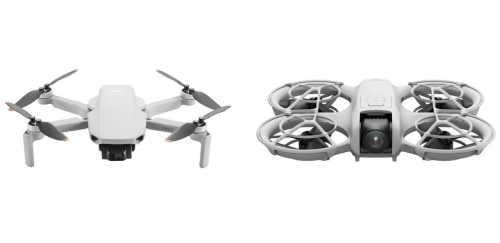
Why Do I Recommend The DJI Mini 2?
- The DJI Mini 2 features a 3-axis mechanical gimbal for stabilizing footage during wind and directional movement to produce smoother aerial video, whereas the DJI Neo uses electronic stabilization.
- DJI Mini 2 has OcuSync 2.0 transmission for maintaining a stable live video feed and responsive control at distances up to 10 km, while the DJI Neo uses a Wi-Fi connection.
- It comes with a maximum 31 minutes flight time for longer aerial recording sessions and fewer battery swaps during travel shoots, while the DJI Neo provides about 18 minutes of flight time.
- The DJI Mini 2 supports up to 256 GB microSD cards for storing large volumes of 4K footage and high-resolution photos during extended flights, while the DJI Neo uses fixed internal storage.
- DJI Mini 2 includes RAW (DNG) photo capture for greater flexibility when adjusting exposure, color balance, and detail during post-processing, whereas the DJI Neo uses JPEG photo format.
- It features a dedicated DJI RC-N1 remote controller for more precise stick control and improved signal stability during long-distance flights, while the DJI Neo uses smartphone-based control.
- The DJI Mini 2 supports up to 100 Mbps video bitrate for preserving more image detail and reducing compression artifacts in 4K recordings, whereas the DJI Neo uses a lower unspecified bitrate.
- DJI Mini 2 has a foldable airframe design for compact packing in travel bags and easier transport during outdoor filming trips, while the DJI Neo uses a fixed non-folding frame.
Maybe the DJI Neo can make you comfortable because it’s a little bit cheaper than the DJI Mini 2. But you have to compromise all the above-mentioned features. Now the Decision is Yours. I hope it was helpful to choose the right one.
Side-by-Side Comparison
| Feature | DJI Mini 2 | DJI Neo |
| Aircraft Type | Foldable quadcopter | Non-folding micro drone |
| Maximum Flight Time | 31 minutes | 18 minutes |
| Battery Type | LiPo 2S | Li-ion |
| Camera Sensor Size | 1/2.3-inch CMOS | 1/2-inch CMOS |
| Lens Equivalent Focal Length | 24 mm | 13–14 mm |
| Stabilization | 3-axis mechanical gimbal | Electronic stabilization |
| Photo Format | JPEG / RAW | JPEG |
| Video Resolution | 4K 30fps / 2.7K 60fps | 4K 30fps / 1080p 60fps |
| Video Bitrate | 100 Mbps | Not specified |
| Zoom | 4× digital | Not specified |
| Transmission System | OcuSync 2.0 | Wi-Fi |
| Maximum Transmission Distance | 10 km | App-based connection |
| External Storage | microSD up to 256 GB | Not supported |
| Max Ascent Speed | 5 m/s | 3 m/s |
| Max Descent Speed | 3.5 m/s | 2 m/s |
| Wind Resistance | 8.5–10.5 m/s | ~8 m/s |
| Remote Controller | DJI RC-N1 controller | Smartphone or optional controller |
| Price | Check DJI Mini 2 Price | Check DJI Neo Price |
What Common Both Can Do?
- 4K Video Recording: Both drones support 4K video capture, allowing users to record ultra-high-definition footage with detailed textures and clarity. This capability ensures that aerial videos appear sharp and suitable for social media, travel content, or professional editing workflows.
- 12 MP Photo Resolution: Each drone captures still images at 12 megapixels, enabling users to take detailed aerial photographs with balanced color and clarity. This resolution provides sufficient detail for online sharing, basic editing, and printing small to medium-sized photos.
- Electronic Image Stabilization: Both models use electronic stabilization algorithms to help smooth footage during flight. This technology reduces small vibrations and movement shifts so that aerial videos remain watchable and visually stable.
- Intelligent Flight Modes: Both drones include automated flight modes designed to simplify aerial filming. These modes allow the drone to follow preset flight paths or perform cinematic movements without requiring advanced piloting skills.
- QuickShots Automated Shots: Each drone supports QuickShots modes that automatically execute pre-programmed camera movements. These modes help users create professional-looking aerial clips with minimal manual control.
- GPS Positioning: Both drones use GPS-based positioning to maintain stable hovering and accurate location tracking. This positioning system improves flight stability and helps the drone hold its position even when the pilot is not actively adjusting the controls.
- Return-to-Home (RTH): Both aircraft include a Return-to-Home safety function that can automatically fly the drone back to its takeoff point. This feature becomes especially important when the battery runs low or the connection between the drone and controller weakens.
- Downward Vision Sensors: Each drone includes downward sensors that help detect the ground and assist with stable hovering. These sensors allow the aircraft to maintain consistent altitude and perform smoother landings.
- Brushless Motors: Both drones use brushless motors, which provide efficient propulsion and reduced mechanical wear compared with brushed motor systems. This motor type helps maintain reliable performance and longer operational life.
- Lithium-based Battery: Both aircraft rely on lithium-based rechargeable batteries for power. These batteries deliver the high energy density required for compact drones to maintain stable flight for extended durations.
- USB Charging Support: Each drone supports charging through a USB-based interface or compatible charger. This design allows users to recharge batteries conveniently using portable chargers, adapters, or charging hubs.
- DJI Fly Mobile App Support: Both drones connect to the DJI Fly application for flight control, camera settings, and live video monitoring. The app interface centralizes navigation controls, camera configuration, and firmware updates.
- Automatic Takeoff: Both drones feature automatic takeoff functionality, enabling users to launch the aircraft with a single command. This simplifies the start of a flight session and reduces the need for manual throttle control.
- Automatic Landing: Each drone also supports automatic landing features that guide the aircraft safely back to the ground. The system adjusts descent speed and stabilization to minimize abrupt contact during landing.
- Smartphone Live View: Both drones stream live camera footage directly to a connected smartphone display. This real-time video feed allows the pilot to frame shots accurately and monitor the drone’s surroundings during flight.
- 3-Axis Flight Stabilization Algorithms: Both aircraft rely on internal stabilization systems that combine gyroscopes, accelerometers, and flight control algorithms. These systems keep the drone balanced and responsive while maneuvering in the air.
- Wind Resistance Stabilization: Both drones include built-in flight control systems designed to maintain stability in moderate wind conditions. These systems continuously adjust motor speeds to counter wind drift and maintain a controlled flight path.
Common Features
| Feature | DJI Mini 2 | DJI Neo |
| 4K Video Recording | Yes | Yes |
| 12 MP Photo Resolution | 12 MP | 12 MP |
| Electronic Image Stabilization | Yes | Yes |
| Intelligent Flight Modes | Yes | Yes |
| QuickShots Automated Shots | Yes | Yes |
| GPS Positioning | Yes | Yes |
| Return-to-Home (RTH) | Yes | Yes |
| Downward Vision Sensors | Yes | Yes |
| Brushless Motors | Yes | Yes |
| Lithium-based Battery | Yes | Yes |
| USB Charging Support | Yes | Yes |
| DJI Fly Mobile App Support | Yes | Yes |
| Automatic Takeoff | Yes | Yes |
| Automatic Landing | Yes | Yes |
| Smartphone Live View | Yes | Yes |
| 3-Axis Flight Stabilization Algorithms | Yes | Yes |
| Wind Resistance Stabilization | Yes | Yes |
| Price | Check DJI Mini 2 Price | Check DJI Neo Price |
FAQ
Which drone is lighter between DJI Mini 2 and DJI Neo? Which drone has a longer flight time? Which drone has better camera stabilization? Do both drones record 4K video? Which drone has internal storage? Does DJI Mini 2 support microSD cards? Which drone has a longer control range? Do both drones support GPS positioning? Can both drones return automatically to the takeoff point? Which drone is easier for beginners to fly? Do both drones support automated shooting modes? Which drone has built-in propeller guards? Can both drones connect to the DJI Fly app? Which drone is better for travel and portability? |