ELEGOO Jupiter SE & ELEGOO Saturn 4 Ultra share many similarities, but there are also important differences, such as quality, performance, features, design, and connectivity. If you want the best one between them, I Would recommend the ELEGOO Jupiter SE rather than the ELEGOO Saturn 4 Ultra.
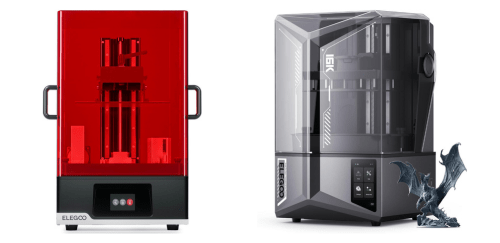
Why Do I Recommend The ELEGOO Jupiter SE?
- The ELEGOO Jupiter SE has a 277.848 × 156.264 × 300 mm build volume for printing taller full-scale helmets and large multipart prototypes in a single job without splitting models, while the Elegoo saturn 4 ultra has a 218.88 × 122.88 × 220 mm build volume.
- ELEGOO Jupiter SE features a 300 mm Z-axis height for producing elongated architectural models and vertically oriented parts without reorientation, whereas the the Elegoo saturn 4 ultra has a 220 mm Z-axis height.
- It comes with a 12.8-inch monochrome LCD for exposing a wider resin surface area per layer to maximize batch production capacity, while the Elegoo saturn 4 ultra uses a 10-inch monochrome LCD.
- The ELEGOO Jupiter SE includes a laser-engraved build plate for maintaining strong first-layer grip on heavy large-format prints during long-duration jobs, whereas the Elegoo saturn 4 ultra uses a standard textured plate system.
- ELEGOO Jupiter SE has a 6K resolution of 5448 × 3064 across a larger panel for balancing surface detail with extended panel lifespan under high-output production workloads, while the Elegoo saturn 4 ultra uses a 12K 11520 × 5120 panel focused on pixel density.
- It features a dual linear rail Z-axis structure for maintaining vertical alignment stability when printing tall 300 mm models under heavy build plate loads, while the Elegoo saturn 4 ultra uses a tilt-release motion system for layer separation.
- The ELEGOO Jupiter SE supports large-format resin vat capacity for reducing refill frequency during long high-volume print sessions, whereas the Elegoo saturn 4 ultra uses a smaller vat aligned with its compact build size.
- ELEGOO Jupiter SE comes with an enclosed large-frame chassis design for maintaining structural rigidity during extended multi-hour prints of oversized components, while the Elegoo saturn 4 ultra uses a more compact chassis configuration.
Maybe the ELEGOO Saturn 4 Ultra can make you comfortable because it’s a little bit cheaper than the ELEGOO Jupiter SE. But you have to compromise all the above-mentioned features. Now the Decision is Yours. I hope it was helpful to choose the right one.
Side-by-Side Comparison
| Feature | ELEGOO Jupiter SE | ELEGOO Saturn 4 Ultra |
| LCD size | 12.8-inch mono LCD | 10.0-inch mono LCD |
| XY resolution | 51 μm | 19 × 24 μm |
| Build volume (mm) | 277.848 × 156.264 × 300 | 218.88 × 122.88 × 220 |
| Build volume (in) | 10.94 × 6.15 × 11.81 | 8.6 × 4.8 × 8.6 |
| Print speed spec | 1–3 s/layer @ 0.05 mm | 150 mm/h |
| Layer thickness | 0.01–0.2 mm | Not specified |
| Leveling method | Manual leveling | Automatic leveling |
| Light source | COB + refractive lens | COB + Fresnel collimation lens |
| Build plate surface | Laser-engraved | Not specified |
| LCD screen protector | PET scratch-resistant film | Not specified |
| Price | Check ELEGOO Jupiter SE Price | Check ELEGOO Saturn 4 Ultra Price |
What Common Both Can Do?
- Printer Type: Both models use MSLA resin printing technology, which relies on masked stereolithography to cure liquid resin layer by layer. This method enables high-detail prints and smooth surface finishes suitable for miniatures, prototypes, and industrial parts.
- Light Source Type: Each printer utilizes a COB UV LED light source to provide consistent light intensity across the build plate. Uniform light distribution ensures predictable curing and dimensional consistency throughout the print.
- UV Wavelength: Both operate at 405 nm UV wavelength, which is the industry standard for resin 3D printing. This compatibility allows users to choose from a wide range of third-party resins without hardware limitations.
- Monochrome LCD: The printers are equipped with monochrome LCD screens designed for higher light transmission and longer operational lifespan. Monochrome panels also support faster curing times compared to RGB screens.
- Resin Compatibility: Each machine supports standard 405 nm UV-sensitive photopolymer resins. This ensures flexibility for users working with standard, ABS-like, flexible, or water-washable materials.
- Slicer Compatibility: Both support CHITUBOX and similar slicing software. This makes workflow management straightforward and ensures access to advanced slicing controls such as support customization and exposure tuning.
- File Transfer: Each printer supports USB-based file transfer for offline printing. This method provides stable data transfer without requiring continuous network connectivity.
- Z-Axis Linear Rail: Both machines use a linear rail system for vertical movement. Linear rails improve mechanical stability and help maintain consistent layer alignment during long prints.
- Metal Build Structure: The chassis of both printers is constructed from metal components. A rigid structure reduces vibration and enhances dimensional accuracy.
- Removable Resin Vat: Each model includes a removable resin vat for easy cleaning and resin changes. This design simplifies maintenance and material switching.
- Replaceable FEP Film: Both use a replaceable FEP film at the bottom of the resin vat. The film acts as a release surface and can be replaced when worn, extending printer usability.
- Touchscreen Interface: Each printer features a touchscreen interface for navigation and print control. Touchscreens allow intuitive access to settings, calibration, and file selection.
- Air Filtration System: Both models include an internal air filtration system to reduce resin odors during operation. This feature improves usability in enclosed indoor environments.
- Overheat Protection: Each printer includes thermal protection mechanisms to prevent overheating. Maintaining stable operating temperatures helps protect internal electronics and ensures consistent curing performance.
- Firmware Update Support: Both printers allow firmware updates to maintain compatibility and system stability. Firmware updates can improve performance, add features, and address operational refinements.
- Adjustable Layer Height: Each model allows users to configure layer heights for different print requirements. Smaller layer heights support finer detail, while thicker layers reduce total print time.
- Anti-Aliasing Support: Both systems support anti-aliasing settings within slicing software. Anti-aliasing helps smooth pixel edges and refine surface quality on detailed models.
- Protective UV Cover: Each printer includes a UV-blocking cover to shield resin from ambient light exposure. This protects print integrity and enhances operational safety.
Common Features
| Feature | ELEGOO Jupiter SE | ELEGOO Saturn 4 Ultra |
| Printer Type | MSLA Resin 3D Printer | MSLA Resin 3D Printer |
| Light Source Type | COB UV LED | COB UV LED |
| UV Wavelength | 405 nm | 405 nm |
| Monochrome LCD | Yes | Yes |
| Resin Compatibility | 405 nm UV Resin | 405 nm UV Resin |
| Slicer Compatibility | CHITUBOX Supported | CHITUBOX Supported |
| File Transfer | USB | USB |
| Z-Axis Linear Rail | Yes | Yes |
| Metal Build Structure | Yes | Yes |
| Removable Resin Vat | Yes | Yes |
| Replaceable FEP Film | Yes | Yes |
| Touchscreen Interface | Yes | Yes |
| Air Filtration System | Yes | Yes |
| Overheat Protection | Yes | Yes |
| Firmware Update Support | Yes | Yes |
| Adjustable Layer Height | Yes | Yes |
| Anti-Aliasing Support | Yes | Yes |
| Protective UV Cover | Yes | Yes |
| Price | Check ELEGOO Jupiter SE Price | Check ELEGOO Saturn 4 Ultra Price |
FAQ
Which printer has higher screen resolution? Which model offers a larger build volume? Does ELEGOO Saturn 4 Ultra support automatic leveling? Do both printers support 405 nm resin? Which printer supports WiFi connectivity? Do both printers use monochrome LCD screens? Is there a difference in XY resolution between the two models? Do both printers have a linear rail Z-axis system? Which printer includes a tilt-release mechanism? Do both printers support firmware updates? Is air filtration available on both printers? Which printer is better suited for very large models? Do both printers support adjustable layer thickness? Are both printers compatible with CHITUBOX slicing software? |