Netgear C7800 vs Arris SBG8300 – Check Which One Is Best & Why?

NETGEAR C7800 & ARRIS SURFboard SBG8300 share many similarities, but there are also important differences, such as quality, performance, features, design, and connectivity. If you want the best one between them, I Would recommend the NETGEAR C7800 rather than the ARRIS SURFboard SBG8300.
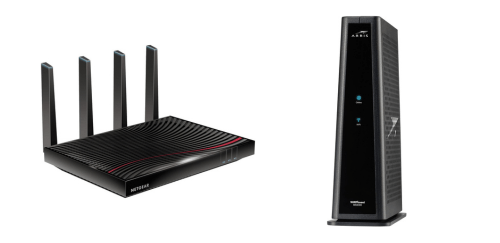
Why Do I Recommend The NETGEAR C7800?

  • The NETGEAR C7800 features AC3200 Wi-Fi with a combined 3200 Mbps rating for higher theoretical wireless throughput across both bands during simultaneous streaming and gaming, while the ARRIS SBG8300 features AC2350 Wi-Fi with a 2350 Mbps combined rating.
  • NETGEAR C7800 comes with 4×4 spatial streams on the 2.4 GHz band for improved data handling capacity when multiple legacy and IoT devices are connected at the same time, whereas the ARRIS SBG8300 uses a 3×3 configuration on the 2.4 GHz band.
  • It includes 2200 Mbps maximum speed on the 5 GHz band for higher peak transfer rates when downloading large files or streaming high-bitrate content, while the ARRIS SBG8300 supports up to 1750 Mbps on 5 GHz.
  • The NETGEAR C7800 supports link aggregation on its Gigabit Ethernet ports to enable combined bandwidth for compatible NAS devices or high-throughput wired setups, while the ARRIS SBG8300 does not list link aggregation support.
  • NETGEAR C7800 comes with two USB 3.0 ports for connecting external storage drives and enabling local network file sharing or automated backups, whereas the ARRIS SBG8300 includes no USB ports.
  • It features ReadySHARE and ReadySHARE Vault functionality for centralized file access and scheduled PC backups across the network, while the ARRIS SBG8300 does not include built-in USB storage sharing software.
  • The NETGEAR C7800 uses four external high-performance active antennas for adjustable signal positioning and directed coverage optimization, while the ARRIS SBG8300 uses internal antenna arrays.
  • NETGEAR C7800 includes dual-core 1.5 GHz processor for dedicated routing and traffic management performance under heavy network loads, whereas the ARRIS SBG8300 specification emphasizes a multi-processor design.

Maybe the ARRIS SURFboard SBG8300 can make you comfortable because it’s a little bit cheaper than the NETGEAR C7800. But you have to compromise all the above-mentioned features. Now the Decision is Yours. I hope it was helpful to choose the right one.

Side-by-Side Comparison

FeatureNETGEAR C7800ARRIS SBG8300
Wi-Fi classAC3200AC2350
Rated max Wi-Fi speed3200 Mbps2350 Mbps
Rated 2.4 GHz speed1000 Mbps600 Mbps
Rated 5 GHz speed2200 Mbps1750 Mbps
2.4 GHz spatial streams4×43×3
USB ports2 × USB 3.0None
DLNA media serverYesNot listed
USB storage sharing feature setReadySHARE / ReadySHARE VaultNot listed
Operating temperature0–40°C0–50°C
PriceCheck NETGEAR C7800 PriceCheck ARRIS SBG8300 Price

What Common Both Can Do?

  • DOCSIS 3.1 support: Both devices support DOCSIS 3.1, enabling multi-gigabit cable internet compatibility. This ensures they can work with modern high-speed cable plans and future network upgrades from ISPs.
  • DOCSIS 3.0 backward compatibility: Each model maintains backward compatibility with DOCSIS 3.0 networks. This allows installation in areas where DOCSIS 3.1 has not yet been fully deployed.
  • Integrated cable modem + Wi-Fi router: Both units combine a cable modem and wireless router into a single chassis. This reduces equipment clutter and eliminates the need for a separate standalone modem.
  • 32×8 DOCSIS 3.0 channel bonding: Both support 32 downstream and 8 upstream bonded DOCSIS 3.0 channels. Channel bonding increases bandwidth efficiency and improves stability under heavy traffic loads.
  • OFDM downstream channels: Each device includes OFDM support for DOCSIS 3.1 downstream communication. OFDM improves spectral efficiency and enables higher throughput over cable networks.
  • OFDMA upstream channels: Both use OFDMA technology for upstream traffic under DOCSIS 3.1. This enhances upstream efficiency and reduces latency in upload-intensive tasks.
  • Dual-band Wi-Fi (2.4 GHz + 5 GHz): Both gateways transmit on 2.4 GHz and 5 GHz bands simultaneously. This allows legacy devices to connect on 2.4 GHz while high-speed devices use 5 GHz.
  • 802.11ac Wi-Fi standard: Each model supports the 802.11ac Wi-Fi standard. This enables higher throughput compared to older 802.11n-only routers.
  • Gigabit Ethernet LAN ports: Both include four 1 Gbps Ethernet LAN ports. These ports allow wired devices such as PCs, gaming consoles, or smart TVs to connect at full gigabit speeds.
  • IPv4 / IPv6 support: Both gateways support IPv4 and IPv6 networking protocols. IPv6 compatibility ensures readiness for modern ISP deployments and expanded IP address capacity.
  • WPA / WPA2 wireless security: Each unit supports WPA and WPA2 encryption standards. This protects wireless networks from unauthorized access and maintains data privacy.
  • Guest Wi-Fi network support: Both allow creation of separate guest networks. This enables visitors to access the internet without exposing the main private network.
  • Web-based management interface: Each device provides browser-based configuration access. This allows users to manage network settings without installing special desktop software.
  • ISP compatibility (major US cable providers): Both models are compatible with major cable internet providers. This ensures broad deployment flexibility across supported cable networks.
  • NAT routing functionality: Both gateways provide Network Address Translation routing. NAT enables multiple devices to share a single public IP address securely.
  • Firewall protection: Each includes built-in firewall protection. This adds an additional security layer against unauthorized inbound traffic.
  • LED status indicators: Both units include front-panel LED indicators. These lights provide quick visual feedback for power, internet connectivity, Wi-Fi activity, and Ethernet status.
  • Vertical desktop form factor: Each device uses a vertical tower-style enclosure. This design supports stable placement on desks or shelves while allowing internal airflow for cooling.

Common Features

FeatureNETGEAR C7800ARRIS SURFboard SBG8300
DOCSIS 3.1 supportYesYes
DOCSIS 3.0 backward compatibilityYesYes
Integrated cable modem + Wi-Fi routerYesYes
32×8 DOCSIS 3.0 channel bondingYesYes
OFDM downstream channelsYesYes
OFDMA upstream channelsYesYes
Dual-band Wi-Fi (2.4 GHz + 5 GHz)YesYes
802.11ac Wi-Fi standardYesYes
Gigabit Ethernet LAN ports4 × 1 Gbps4 × 1 Gbps
IPv4 / IPv6 supportYesYes
WPA / WPA2 wireless securityYesYes
Guest Wi-Fi network supportYesYes
Web-based management interfaceYesYes
ISP compatibility (major US cable providers)YesYes
NAT routing functionalityYesYes
Firewall protectionYesYes
LED status indicatorsYesYes
Vertical desktop form factorYesYes
Price Check NETGEAR C7800 Price
Check ARRIS SBG8300 Price

FAQ

Is NETGEAR C7800 faster than ARRIS SBG8300 in Wi-Fi performance?
Yes, the NETGEAR Nighthawk C7800 is rated at AC3200 (3200 Mbps total), while the ARRIS SURFboard SBG8300 is rated at AC2350 (2350 Mbps total). The higher wireless class rating of the NETGEAR C7800 reflects higher theoretical combined throughput across its dual bands.

Do both NETGEAR C7800 and ARRIS SBG8300 support DOCSIS 3.1?
Yes, both gateways support DOCSIS 3.1, allowing compatibility with modern multi-gigabit cable internet plans. They also maintain backward compatibility with DOCSIS 3.0 networks.

How many Ethernet ports are available on each device?
Both NETGEAR C7800 and ARRIS SBG8300 include four 1 Gbps Ethernet LAN ports. This allows up to four wired devices to connect at gigabit speeds without an external switch.

Does either model support link aggregation?
The NETGEAR C7800 supports link aggregation on its Ethernet ports, while the ARRIS SBG8300 does not list link aggregation support in its standard specifications. Link aggregation allows combining two Ethernet ports for higher potential throughput to supported devices.

Do both devices provide dual-band Wi-Fi?
Yes, both gateways operate on 2.4 GHz and 5 GHz bands simultaneously. This allows compatibility with older wireless devices and high-speed support for newer ones.

Does the ARRIS SBG8300 support MU-MIMO?
Yes, the ARRIS SBG8300 explicitly supports MU-MIMO, which allows multiple compatible devices to receive data simultaneously. The NETGEAR C7800 specification does not prominently list MU-MIMO in the same way.

Are USB ports available on both models?
The NETGEAR C7800 includes two USB 3.0 ports for storage sharing and backup features. The ARRIS SBG8300 does not include USB ports.

Can both models create a guest Wi-Fi network?
Yes, both devices support guest network functionality. This allows separation between the primary network and visitor access.

What is the maximum rated Wi-Fi speed on 5 GHz for each model?
The NETGEAR C7800 is rated at up to 2200 Mbps on the 5 GHz band. The ARRIS SBG8300 is rated at up to 1750 Mbps on the 5 GHz band.

Are both devices compatible with major cable ISPs?
Yes, both models are approved for use with major cable internet providers, subject to ISP compatibility lists. Activation typically requires registering the modem’s MAC address with the provider.

Do both units include built-in firewall protection?
Yes, both gateways include integrated firewall and NAT routing functionality. This provides a basic security layer against unauthorized inbound traffic.

What are the physical size differences between the two devices?
The NETGEAR C7800 measures approximately 12.4 × 10.4 × 7.5 inches and weighs about 3.15 lb. The ARRIS SBG8300 measures approximately 9.33 × 2.87 × 8.0 inches and weighs about 1.94 lb.

What operating temperature ranges do they support?
The NETGEAR C7800 is rated for operation between 0–40°C. The ARRIS SBG8300 is rated for operation between 0–50°C.

Do both devices support IPv6 networking?
Yes, both models support IPv4 and IPv6 protocols. This ensures compatibility with modern ISP network deployments.

Is either device suitable for high-speed gigabit internet plans?
Yes, both devices support DOCSIS 3.1 and include four Gigabit Ethernet ports, making them suitable for gigabit-class cable internet plans. Actual achievable speeds depend on ISP provisioning and local network conditions.