NETGEAR AX5400 & NETGEAR AX5200 share many similarities, but there are also important differences, such as quality, performance, features, design, and connectivity. If you want the best one between them, I Would recommend the NETGEAR AX5400 rather than the NETGEAR AX5200.
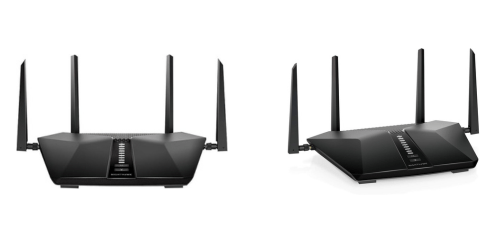
Why Do I Recommend The NETGEAR AX5400?
- The NETGEAR AX5400 has a 5.4 Gbps combined dual-band Wi-Fi capacity for higher peak wireless throughput during large file transfers and 4K streaming sessions, while the NETGEAR AX5200 has a 5.2 Gbps tri-band rating.
- NETGEAR AX5400 features a 4800 Mbps 5GHz band for faster single-device downloads and lower latency gaming performance on compatible Wi-Fi 6 clients, whereas the NETGEAR AX5200 uses a 2400 Mbps 5GHz client band.
- It comes with a 1.5 GHz triple-core processor for quicker packet processing and reduced buffering when multiple high-bandwidth applications run simultaneously, while the NETGEAR AX5200 uses a 1.0 GHz dual-core processor.
- The NETGEAR AX5400 includes 4 Gigabit LAN ports for connecting multiple wired devices such as gaming consoles and desktop PCs without an external switch, whereas the NETGEAR AX5200 router unit includes 3 Gigabit LAN ports.
- NETGEAR AX5400 has a USB 3.0 port for connecting external storage drives to enable local network file sharing and media streaming, while the NETGEAR AX5200 includes no USB port.
- It supports 160 MHz channel width on its primary 5GHz band for achieving higher throughput on compatible Wi-Fi 6 devices in close-range setups, whereas the NETGEAR AX5200 splits bandwidth across tri-band architecture with a dedicated backhaul channel.
- NETGEAR AX5400 features four high-gain external antennas for adjustable signal orientation to optimize coverage direction within a specific room layout, while the NETGEAR AX5200 uses fixed internal antennas.
Maybe the NETGEAR AX5200 can make you comfortable because it’s a little bit cheaper than the NETGEAR AX5400. But you have to compromise all the above-mentioned features. Now the Decision is Yours. I hope it was helpful to choose the right one.
Side-by-Side Comparison
| Feature | NETGEAR AX5400 | NETGEAR AX5200 |
| System type | Standalone router | Mesh system |
| Wi-Fi class | AX5400 | AX5200 |
| Max advertised Wi-Fi speed | 5.4 Gbps | 5.2 Gbps |
| 2.4GHz PHY rate | 600 Mbps | 400 Mbps |
| 5GHz client PHY rate | 4800 Mbps | 2400 Mbps |
| Spatial streams | 6-stream | 4-stream |
| CPU | Triple-core 1.5 GHz | Dual-core 1.0 GHz |
| Ethernet ports (router unit) | 1×1GbE WAN + 4×1GbE LAN | 1×1GbE WAN + 3×1GbE LAN |
| USB ports | 1×USB 3.0 | 0 |
| Weight | 1.25 lb | 1.6 lb |
| Price | Check NETGEAR AX5400 Price | Check NETGEAR AX5200 Price |
What Common Both Can Do?
- Wi-Fi 6 (802.11ax): Both routers support the Wi-Fi 6 standard, which improves spectral efficiency and overall wireless capacity. This allows more devices to connect simultaneously with stable performance in busy households.
- Backward compatibility (802.11a/b/g/n/ac): Each model works with older Wi-Fi standards, ensuring legacy devices remain compatible. This prevents the need to replace existing smartphones, laptops, or IoT devices.
- OFDMA support: Both routers use Orthogonal Frequency Division Multiple Access technology. This enables efficient data transmission by dividing channels into smaller resource units for multiple clients.
- MU-MIMO support: Each device supports Multi-User Multiple Input Multiple Output. This allows simultaneous communication with multiple devices instead of serving them sequentially.
- Beamforming: Both models include beamforming technology. This focuses the wireless signal toward connected devices for stronger and more stable connections.
- WPA3 security: Each router supports WPA3 encryption. This provides stronger password protection and enhanced security against brute-force attacks.
- WPA2 compatibility: Both maintain support for WPA2. This ensures compatibility with older devices that may not yet support WPA3.
- 2.4GHz band: Each router broadcasts on the 2.4GHz frequency band. This band supports extended range and compatibility with IoT devices.
- 5GHz band: Both devices provide 5GHz wireless connectivity. This frequency offers higher throughput and reduced interference compared to 2.4GHz.
- Gigabit Ethernet ports: Both routers include Gigabit Ethernet connectivity. This enables wired connections with speeds up to 1 Gbps for PCs, consoles, and switches.
- NETGEAR Armor support: Each model supports NETGEAR Armor cybersecurity services. This adds network-wide protection against malware and online threats.
- App management: Both can be managed through NETGEAR mobile applications. This allows remote setup, monitoring, and configuration from a smartphone.
- Guest Wi-Fi network: Each router supports separate guest networks. This keeps primary devices isolated from visitor connections.
- Parental controls support: Both models include parental control capabilities. This enables content filtering, time limits, and monitoring for connected devices.
- IPv6 support: Each router supports IPv6 addressing. This ensures compatibility with modern internet infrastructure and future network expansion.
- QoS (Quality of Service): Both devices provide QoS management features. This helps prioritize bandwidth for gaming, streaming, or video calls.
- VPN support (OpenVPN): Each model supports VPN connectivity. This enables secure remote access to the home network.
- Automatic firmware updates: Both routers support firmware update mechanisms. This keeps security patches and performance improvements current.
- Alexa voice control compatibility: Each router integrates with Amazon Alexa. This allows voice commands for enabling guest networks or checking network status.
- Desktop placement: Both models are designed for desktop placement. This allows flexible positioning within home environments for optimal coverage.
Common Features
| Feature | NETGEAR AX5400 | NETGEAR AX5200 |
| Wi-Fi 6 (802.11ax) | Yes | Yes |
| Backward compatibility (802.11a/b/g/n/ac) | Yes | Yes |
| OFDMA support | Yes | Yes |
| MU-MIMO support | Yes | Yes |
| Beamforming | Yes | Yes |
| WPA3 security | Yes | Yes |
| WPA2 compatibility | Yes | Yes |
| 2.4GHz band | Yes | Yes |
| 5GHz band | Yes | Yes |
| Gigabit Ethernet ports | Yes | Yes |
| NETGEAR Armor support | Yes | Yes |
| Nighthawk / Orbi app management | Yes | Yes |
| Guest Wi-Fi network | Yes | Yes |
| Parental controls support | Yes | Yes |
| IPv6 support | Yes | Yes |
| QoS (Quality of Service) | Yes | Yes |
| VPN support (OpenVPN) | Yes | Yes |
| Automatic firmware updates | Yes | Yes |
| Alexa voice control compatibility | Yes | Yes |
| Wall / desktop placement | Desktop placement | Desktop placement |
| Price | Check NETGEAR AX5400 Price | Check NETGEAR AX5200 Price |
FAQ
Do both NETGEAR AX5400 and NETGEAR AX5200 support Wi-Fi 6? Is the maximum advertised speed the same on both models? Do both routers support MU-MIMO and OFDMA? Does the NETGEAR AX5200 have a dedicated backhaul band? Are both routers compatible with older Wi-Fi devices? Do both models support WPA3 security? Can I create a guest network on both routers? Do both routers support parental controls? Are both routers manageable through a mobile app? Do both models include Gigabit Ethernet ports? Is USB storage sharing available on both routers? Do both routers support IPv6? Are both models compatible with voice assistants like Alexa? Which model is better for larger homes? |