Netgear AX5200 & Netgear AX4300 share many similarities, but there are also important differences, such as quality, performance, features, design, and connectivity. If you want the best one between them, I Would recommend the Netgear AX5200 rather than the Netgear AX4300.
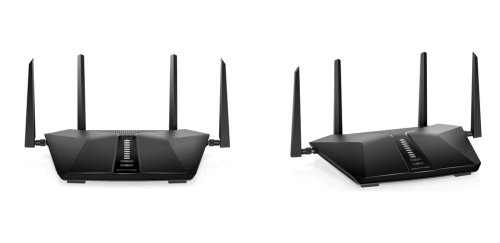
Why Do I Recommend The Netgear AX5200?
- The Netgear AX5200 supports a maximum aggregate speed 5200 Mbps for handling simultaneous 4K streaming, online gaming, and large file transfers without congestion, while the Netgear AX4300 supports a maximum aggregate speed of 4300 Mbps.
- Netgear AX5200 features a 5 GHz band speed of up to 4400 Mbps for maintaining higher throughput during bandwidth-intensive activities such as cloud backups and game downloads, whereas the Netgear AX4300 supports up to 3500 Mbps on the 5 GHz band.
- It comes with a 1.8 GHz quad-core processor for processing heavy network traffic, VPN sessions, and QoS prioritization with reduced latency under load, while the Netgear AX4300 uses a 1.5 GHz quad-core processor.
- The Netgear AX5200 includes 1 GB RAM for maintaining stable performance when managing dozens of connected devices and background services simultaneously, while the Netgear AX4300 includes 512 MB RAM.
- Netgear AX5200 features 512 MB flash storage for supporting larger firmware packages and advanced network features without storage limitations, whereas the Netgear AX4300 includes 256 MB flash storage.
- It supports a 2.5 Gigabit Ethernet port for connecting multi-gig switches or high-speed NAS systems without being limited to 1 Gbps wired throughput, while the Netgear AX4300 includes only standard 1 Gigabit Ethernet ports.
- The Netgear AX5200 includes five Gigabit LAN ports for connecting multiple wired devices such as gaming consoles, desktop PCs, and smart TVs without requiring an external switch, whereas the Netgear AX4300 includes four Gigabit LAN ports.
- Netgear AX5200 features six external antennas for distributing wireless signals across wider indoor coverage zones and maintaining stronger signal consistency through walls, while the Netgear AX4300 uses four external antennas.
Maybe the Netgear AX4300 can make you comfortable because it’s a little bit cheaper than the Netgear AX5200. But you have to compromise all the above-mentioned features. Now the Decision is Yours. I hope it was helpful to choose the right one.
Side-by-Side Comparison
| Feature | Netgear AX5200 | Netgear AX4300 |
| Aggregate Wi-Fi Speed (Max) | 5200 Mbps | 4300 Mbps |
| 5 GHz Max PHY Rate | 4400 Mbps | 3500 Mbps |
| Total Antenna Count | 6 external antennas | 4 external antennas |
| CPU Cores | 1.8 GHz quad-core | 1.5 GHz quad-core |
| RAM Size | 1 GB | 512 MB |
| Flash Storage | 512 MB | 256 MB |
| LAN Ports | 5 × 1 GbE | 4 × 1 GbE |
| Multi-Gig LAN Port | 1 × 2.5 GbE LAN | None |
| Target Client Density | 40+ clients | 30-35 clients |
| Power Consumption (Typical) | 25 W | 18 W |
| Price | Check Netgear AX5200 Price | Check Netgear AX4300 Price |
What Common Both Can Do?
- Wi-Fi 6 (802.11ax): Both routers use the Wi-Fi 6 standard, which improves efficiency, latency handling, and multi-device communication. This ensures better performance in homes with many connected devices such as smartphones, laptops, and smart home equipment.
- Dual-Band Support: Each router operates on both 2.4 GHz and 5 GHz frequency bands. This allows users to balance long-range coverage on 2.4 GHz and higher-speed performance on 5 GHz.
- Backward Compatibility: Both models support older Wi-Fi standards including 802.11a/b/g/n/ac. This ensures legacy devices can still connect without requiring hardware upgrades.
- OFDMA: Both routers include Orthogonal Frequency Division Multiple Access technology. This allows simultaneous communication with multiple devices by dividing channels into smaller sub-channels, improving network efficiency.
- MU-MIMO: Each router supports Multi-User Multiple Input Multiple Output. This enables multiple devices to receive data streams at the same time instead of waiting sequentially.
- Beamforming: Both devices include beamforming technology. This directs Wi-Fi signals toward connected devices instead of broadcasting uniformly, improving signal reliability.
- WPA3 Security: Each router supports WPA3 encryption. This enhances wireless security by strengthening password-based authentication and encryption protocols.
- Gigabit WAN Port: Both models include a 1 Gigabit Ethernet WAN port. This supports high-speed broadband connections up to 1 Gbps from an ISP.
- Gigabit LAN Ports: Each router provides Gigabit Ethernet LAN connectivity. This allows wired devices such as PCs and gaming consoles to access full gigabit speeds.
- USB 3.0 Port: Both routers include a USB 3.0 port. This allows connection of external storage for network sharing and media streaming.
- Quad-Core Processor: Each model is powered by a quad-core processor. This enables efficient traffic handling, firewall processing, and stable performance under load.
- Smart Connect: Both routers include Smart Connect functionality. This automatically assigns devices to the most appropriate Wi-Fi band for optimized connectivity.
- Quality of Service (QoS): Each device supports QoS configuration. This allows prioritization of traffic for activities such as gaming, video calls, or streaming.
- Parental Controls: Both models provide parental control features. This enables content filtering, usage scheduling, and monitoring of connected devices.
- Guest Network: Each router allows creation of a separate guest Wi-Fi network. This keeps primary network resources isolated from visitor devices.
- VPN Support: Both routers support VPN configurations. This enables secure remote access and encrypted connections when properly configured.
- Mesh Compatibility: Each model is compatible with Netgear’s mesh ecosystem. This allows expansion of coverage by adding compatible satellites or extenders.
- Web & App Management: Both routers can be managed via the Nighthawk mobile app and web interface. This provides remote setup, monitoring, and configuration options.
- IPv6 Support: Each device supports IPv6 addressing. This ensures compatibility with modern internet infrastructure and future networking requirements.
- Firmware Auto-Update: Both routers support automatic firmware updates. This helps maintain security patches and performance enhancements over time.
Common Features
| Feature | Netgear AX5200 | Netgear AX4300 |
| Wi-Fi Standard | Wi-Fi 6 | Wi-Fi 6 |
| Dual-Band Support | 2.4 GHz + 5 GHz | 2.4 GHz + 5 GHz |
| Backward Compatibility | 802.11a/b/g/n/ac | 802.11a/b/g/n/ac |
| OFDMA | Yes | Yes |
| MU-MIMO | Yes | Yes |
| Beamforming | Yes | Yes |
| WPA3 Security | Yes | Yes |
| Gigabit WAN Port | 1 × 1 GbE | 1 × 1 GbE |
| Gigabit LAN Ports | Yes | Yes |
| USB 3.0 Port | 1 × USB 3.0 | 1 × USB 3.0 |
| Quad-Core Processor | Yes | Yes |
| Smart Connect | Yes | Yes |
| Quality of Service (QoS) | Yes | Yes |
| Parental Controls | Yes | Yes |
| Guest Network | Yes | Yes |
| VPN Support | Yes | Yes |
| Mesh Compatibility | Yes | Yes |
| Web & App Management | Nighthawk App + Web UI | Nighthawk App + Web UI |
| IPv6 Support | Yes | Yes |
| Firmware Auto-Update | Yes | Yes |
| Price | Check Netgear AX5200 Price | Check Netgear AX4300 Price |
FAQ
Do both routers support Wi-Fi 6 technology? Are Netgear AX5200 and AX4300 dual-band routers? Do these routers support backward compatibility with older devices? Is there a difference in LAN port configuration? Do both routers include a USB port for storage sharing? Which router is better for large homes? Do both models support MU-MIMO technology? Is OFDMA available on both routers? Do these routers support WPA3 security? Can both routers be used in a mesh network setup? Do both routers include parental control features? Is there a difference in processor performance? Do both routers support Gigabit internet plans? Are both routers manageable through the Nighthawk app? |